
5 Steps How to Help Your Child With Daytime Accidents and End School Stress (Easy Guide for Parents)

It’s 2:00 PM on a Tuesday. Your phone buzzes on the desk. You see the school’s caller ID, and your heart does a little somersault: not the fun kind. You already know what the nurse is going to say. Another daytime accident. Another trip to the school with a plastic bag of fresh leggings.
If you’ve been living in this cycle of laundry, "oopsies," and school-day anxiety, I want you to take a deep breath. Exhale the stress. Inhale the superpowers. You are not alone, and more importantly, your child isn't "lazy" or "doing this for attention."
At Bladder Breakthrough, we see families every day who are exhausted by the "wet pants patrol." Daytime wetting (clinically known as diurnal enuresis) can feel like a mountain, but we’re here to help you and your little hero climb it. Whether your child is 4 or 12, the path to dry days isn't about punishment: it’s about empowerment, science, and a little bit of Stay Dry Squad™ magic.
Let’s dive into the 5-step roadmap to reclaim your afternoons and turn school stress into school success.
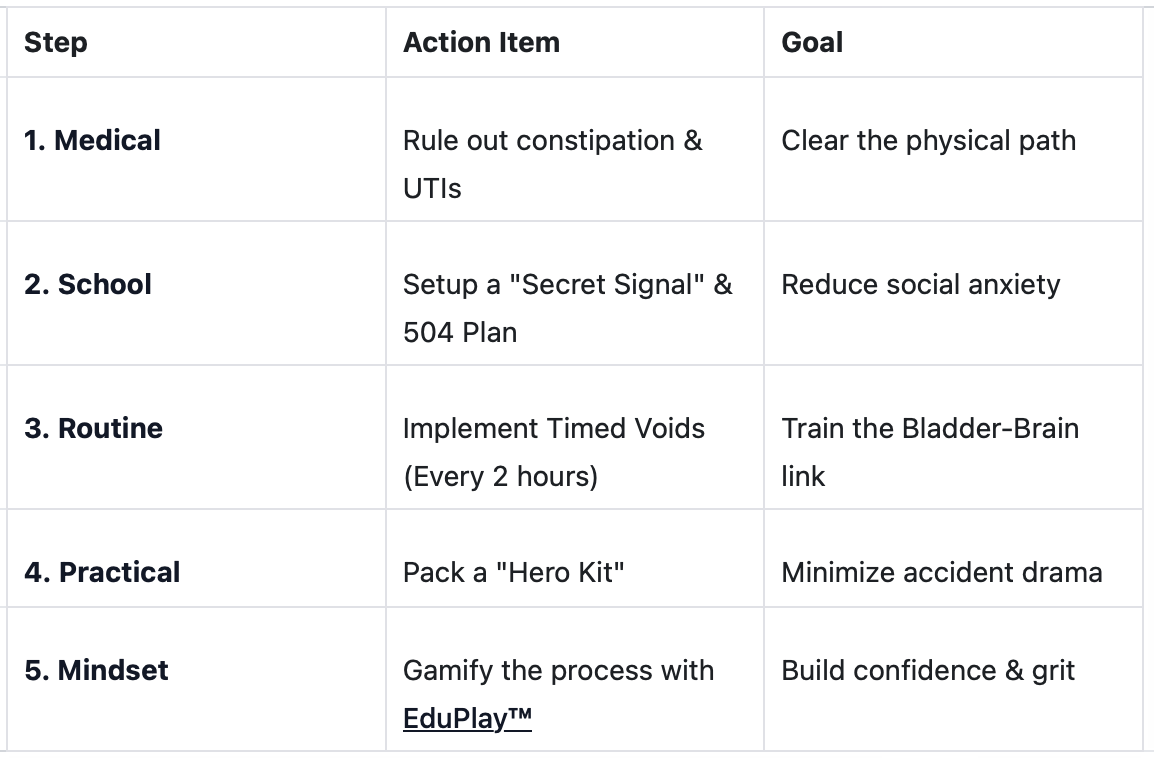
Step 1: Rule Out the Secret Saboteurs (The Medical Check)
Before we start the "Hero Training," we have to make sure the equipment is working right! When a child has frequent daytime accidents, the bladder is often reacting to a hidden bully.
The Constipation Connection
Did you know that the #1 cause of bladder accidents is actually... poop? It sounds wild, but the bladder and the rectum are neighbors. When a child is "backed up" (even if they go every day!), a full rectum can press against the bladder, making it feel full when it’s not, or causing it to twitch and leak. This is why we call constipation the "Secret Bladder Saboteur."
UTIs and Anatomy
Sometimes, a low-grade Urinary Tract Infection (UTI) can cause urgency. Other times, it’s a matter of pelvic floor muscles that haven't quite learned how to coordinate with the brain yet.
What to do:
- See the Pediatrician: Ask for a "KUB" (an X-ray of the belly) to check for hidden constipation.
- Hydration Check: It sounds counterintuitive, but drinking less water makes urine more concentrated, which irritates the bladder and causes more accidents! Check out Why Hydration is the Unsung Hero in Conquering Pediatric Incontinence to see how water actually helps the Stay Dry Squad™ stay in control.

Visual: A diverse group of kids dressed as superheroes, looking confident and ready to tackle the day.
Step 2: The Teacher Team-Up (Ending School Anxiety)
School is the "Final Boss" for kids with daytime accidents. Between the strict bathroom rules, the fear of peers noticing, and the long walk to the nurse's office, it’s no wonder stress levels are through the roof.
To end the school stress, you need to turn the teacher into an ally. Most teachers want to help; they just need a game plan.
The "Secret Signal" Strategy
Nothing is more embarrassing for a 7-year-old than raising their hand and announcing to the class they need to pee: especially if the teacher says, "Can you wait five minutes?" For a child with urgency, five minutes is an eternity.
The Fix: Work with the teacher to create a "Secret Signal." Maybe it's a specific magnet moved on the board, a thumbs-up, or a "hall pass" that sits on the child’s desk. This allows your child to leave discreetly without the social spotlight.
Formalize the Support
If accidents are frequent, consider requesting a 504 Plan. This is a legal document that ensures your child has accommodations, like:
- Unlimited bathroom access.
- A seat located near the classroom door.
- Permission to carry a water bottle (to keep that bladder happy!).
By removing the "gatekeeper" (the teacher's permission), you remove the anxiety. When the brain isn't stressed, the bladder behaves better!
Step 3: Master the "Bladder Bounce" (Timed Routine)
In the world of the Stay Dry Squad™, we don’t wait for the "I have to go!" signal. Why? Because many kids have what we call sensory processing lag. By the time their brain realizes the bladder is full, it’s already too late.
The Timed Voiding Protocol
Instead of waiting for an emergency, we use Timed Voids. This means "peeing by the clock."
- The Schedule: Every 1.5 to 2 hours.
- The Tool: Use a discreet vibrating watch or our Bladder Bounce App Tracker. This turns the "chore" of going to the bathroom into a quest.
Pelvic Floor Power
Sometimes the muscles are just a little confused. They might be "holding" too tight all day, or they might be too weak to shut the "bladder gate." This is where specialized pediatric pelvic health comes in.
> "It’s not just about stopping the leak; it’s about teaching the brain and the bladder to speak the same language again." : Dr. Tiffani S. Bacon, PT
For more on how we turn these exercises into play, explore Theraplay: Empowering Kids Through Playful Bladder Support.

Visual: A mother and daughter sitting together at a computer, smiling as they look at a colorful, gamified app interface.
Step 4: Pack the "Hero Kit" (The Survival Bag)
Accidents might happen during the "training phase," and that’s okay! The goal is to minimize the drama of the accident so it doesn't crush your child's confidence.
We recommend every child keep a Hero Kit in their locker or backpack. This isn't a "shame bag": it's a toolkit for a quick recovery.
What goes inside:
- Two sets of fresh clothes: (Socks included! Leaks travel down).
- Discreet wipes: To feel fresh and clean.
- Ziploc bags: For the wet clothes (keeps the smell away).
- A "Power Card": A little note from you that says, "You’ve got this! You’re a hero in training."
When a child knows they have a plan for an accident, their baseline cortisol (stress hormone) drops. Lower stress = better bladder control. It’s a win-win! If you're looking for more ways to gamify this process, check out The Game Zone: Turning Accidents into Achievements.
Step 5: Level Up with Positive Reinforcement (No Shame, All Game)
If there is one thing we know at Bladder Breakthrough, it’s that shame is the enemy of progress. Punishment, scolding, or making a child "clean their own sheets" as a penalty (rather than a life skill) often backfires, leading to "hidden" accidents.
The Gamification Strategy
We treat bladder health like a video game. You don't get mad at a character for losing a heart; you just learn the pattern and try again!
- Celebrate the "Near Misses": If your child realizes they have to go and makes it halfway to the bathroom before a leak: that’s a win! They felt the signal!
- Use the EduPlay™ Method: Our Stay-Dri EduPlay™ approach uses gaming to teach kids about their internal anatomy. When they see the "Bladder Defender" character on their screen, they start to visualize their own body's strength.
The "Bladder Breakthrough" Celebration:
When you hit a milestone: like 3 days of dry school afternoons: celebrate! Not with something huge, but with a "Victory Dance" or a special "Squad Snack." You can find inspiration for these moments in our 5-Day Challenge Celebration.
Q&A Insights: Helping Families Everywhere
We know that parenting doesn't happen in a vacuum. Whether you're in a busy city or a quiet suburb, the struggle is real. Here are some common questions we get from parents across the country.
Q: My child is 8 and still having accidents in Atlanta. Is it too late to start pelvic floor therapy?
A: Never! In fact, ages 7-12 are the "Sweet Spot" for our digital therapy because kids are old enough to understand the concepts and young enough to love the gamification. Our System & Method for Personalized Pediatric Pelvic Health is designed to work regardless of where you live.
Q: In California, my school says they can't "force" my child to go to the bathroom. What do I do?
A: You’re right: they can’t force them. However, they can be required to provide "cues." This is where a 504 plan comes in. Instead of forcing, the teacher provides a "scheduled prompt." This shifts the responsibility from the child’s forgetful brain to a supportive routine.
Q: We’ve tried everything in New York, including alarms. Nothing works. What’s different about Bladder Breakthrough?
A: Most "solutions" are just patches (like diapers) or alarms that only address the symptom. We focus on the Bladder-Brain Connection. We use edutainment to change how your child thinks about their body. When a child feels like a "Bladder Defender" rather than a "problem kid," the results follow.

Visual: A diverse group of parents standing together in a park, looking supportive and empowered.
Why This Matters: The Emotional Toll
Let’s be real for a second. This isn't just about wet pants. It's about your child’s self-esteem. It’s about them being able to go to a sleepover without fear. It’s about you not dreading every phone call from the school.
When we address daytime accidents with a "Hero Mindset," we aren't just fixing a bladder; we are building a more confident human. We are showing them that even when something is hard, they have the tools to conquer it.
If you’re ready to stop the guesswork and start the transformation, we invite you to join the Bladder Breakthrough Celebration. You don't have to go it alone. The Stay Dry Squad™ is ready to welcome your little hero.
Final Thought:
Transformation isn't a "maybe": it’s a "when." By following these 5 steps, you’re not just managing accidents; you’re reclaiming your child’s childhood.
Ready to level up?
Explore our pricing for individuals and families here.
References & Further Reading
- Hodges, S. J., & Schlosberg, J. (2012). It's No Accident: Breakthrough Solutions to Your Child's Wetting, Constipation, UTIs, and Other Potty Problems. (Focuses on the link between constipation and bladder dysfunction).
- Kiddoo, D. A. (2012). "Diurnal enuresis." Canadian Medical Association Journal. Link to research
- National Institute of Diabetes and Digestive and Kidney Diseases (NIDDK). "Urinary Incontinence in Children." Internal Link: The Ultimate Enuresis Survival Guide
- American Academy of Pediatrics (AAP). "Managing Daytime Wetting."
- Elevacare Health LLC. "Why Hydration is the Unsung Hero." Read more here.
- Bladder Breakthrough. "Fearless & Dry: Why is my child still wetting?" Watch the video.
Key Takeaways for Busy Parents

Visual: A child wearing a superhero cape, standing on top of a "mountain" (a small play hill), looking out at the horizon with a "victory" pose.
Disclaimer: The information provided in this blog is for educational purposes and is not a substitute for professional medical advice. Always consult with your pediatrician or a licensed pelvic health physical therapist like Dr. Tiffani S. Bacon, PT, for personalized care.