

Constipation and Bedwetting: The Surprising Connection Explained in Under 3 Minutes
If you're reading this late at night, quietly scrolling… you're not alone.
Maybe you've tried the alarms. The fluid restrictions. The motivational sticker charts. And yet, your child is still waking up wet.
Before we go any further, I want you to hear this:
You haven't missed something obvious. You may have missed something hidden.
There's a connection between constipation and bedwetting that most parents never hear about. And once you understand it, so much starts to make sense.
Let me explain, in plain English, without shame, and in less time than it takes to reheat your coffee.
Quick heads up: This post is going to go deeper than “under 3 minutes”—because if constipation is the hidden piece in your child’s bedwetting puzzle, you deserve the full, clear, practical guide. Not a quick tip. Not a guess. A plan.
Helpful Resources:
- The Ultimate Enuresis Survival Guide: What Actually Works
- The Power of Gamified Pelvic Floor Training
The Connection No One Talks About
Here's the part most people don't explain:
Constipation and bedwetting are often two symptoms of the same underlying problem.
When stool builds up in the rectum, even if your child is having "regular" bowel movements, it can directly interfere with bladder function. The rectum and bladder are neighbors. They share space. They share nerves. And when one is struggling, the other often shows it.
This isn't a character flaw. It isn't laziness. It isn't a willpower issue.
Biology is not a behavior problem.
The "Crowded Elevator" Analogy
Let's pause here for a moment and picture this:
Imagine your child's bladder as an elevator. It has a certain capacity, a certain number of "passengers" (urine) it can comfortably hold before it needs to empty.
Now imagine someone parks a giant piece of luggage right in the middle of that elevator. That's the rectum when it's full of stool.
Suddenly, the elevator can't hold as many passengers. It fills up faster. The doors want to open sooner. And at night, when your child is in deep sleep and can't consciously control the "doors", accidents happen.

This is exactly what research from Wake Forest Baptist Medical Center found: all 30 children in their bedwetting study had excess stool in their rectums, even though only 3 of them had typical constipation symptoms (Hodges et al., Journal of Urology, 2012).
Read that again.
Most of these kids didn't look constipated. They were having bowel movements. But their rectums were still stretched and full, silently pressing on their bladders every single night.
Why This Gets Missed So Often
This brings us to the part parents care about most: why didn't anyone tell me this?
Here's the truth,
Constipation doesn't always look like constipation.
Many children with this issue:
- Have daily bowel movements (but incomplete ones)
- Don't complain of belly pain
- Don't strain or struggle on the toilet
- Appear totally "fine" during the day
But their rectums are chronically distended. And that distention creates a domino effect:
- Reduced bladder capacity , less room to hold urine
- Bladder overactivity , involuntary contractions during sleep
- Weakened pelvic floor muscles , from chronic pressure and straining
- Nerve interference , disrupted signals between bladder and brain
In simple terms, this means your child's body is working against itself, not because something is broken, but because one system is crowding another.
What the Science Actually Says
Let's connect the dots with what researchers have found.
Studies published in the Journal of Pediatric Urology confirm that rectal distention is strongly associated with nocturnal enuresis (the clinical term for bedwetting). When the rectum is chronically full, it compresses the bladder wall, reduces functional capacity, and triggers involuntary bladder contractions, especially during sleep when conscious control is offline.
Here's the part that often brings parents to tears (in a good way):
> In one study, 83% of children were cured of bedwetting within three months, simply by treating their constipation.
Not with alarms. Not with medication. Not with punishment or pressure.
Just by clearing the "luggage" out of the elevator.
(Hodges et al., Journal of Urology, 2012; Journal of Pediatric Urology, multiple studies)
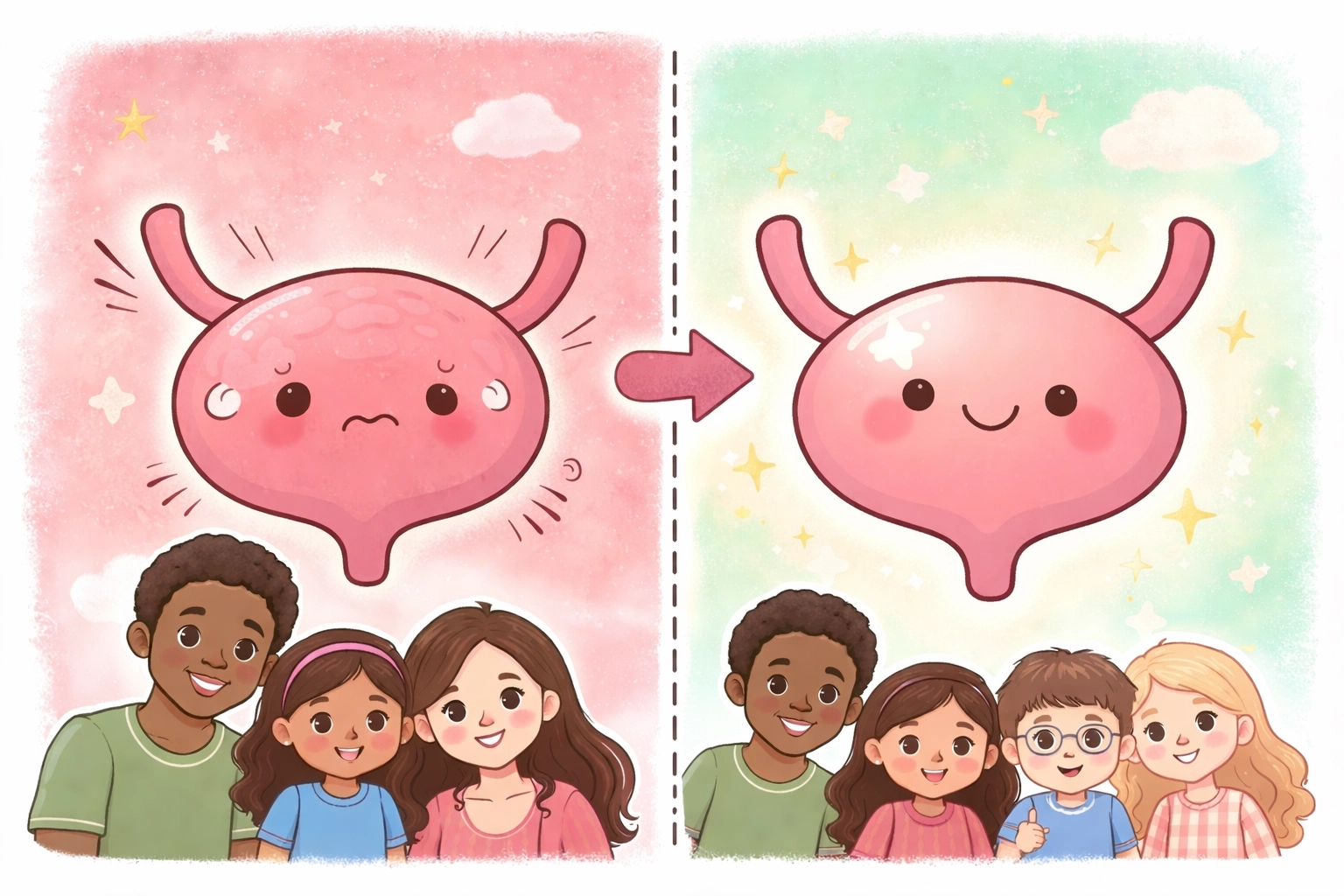
The Bladder’s Neighbor: Meet the Rectum (And Why It Matters So Much)
Parents are often told bedwetting is “developmental” or “genetic”—and those things can be true. But there’s another player in this story that rarely gets the spotlight:
The rectum.
I call it the bladder’s next-door neighbor—because when the rectum is crowded, the bladder pays the price.
Where this all happens (the simple anatomy version)
Your child’s bladder sits in the pelvis. Right behind it? The rectum.
They share a tight neighborhood with the pelvic floor muscles and a whole lot of nerve wiring.
So when the rectum is full of stool, it’s not just a “poop problem.” It can become a space problem and a signal problem.
Constipation doesn’t just “sit there”—it changes capacity
Here’s the part that clicks for many families:
- A chronically full rectum can push forward into the space the bladder needs.
- That pressure can make the bladder feel “full” earlier—even when it isn’t.
- Over time, the rectum can become stretched (distended), which can keep the cycle going.
If your child’s bladder is supposed to be a roomy balloon, constipation can turn it into a balloon being squeezed in someone’s fist.
Capacity 101: “Functional bladder capacity” (the parent-friendly translation)
Clinicians often talk about functional bladder capacity—meaning:
> How much urine the bladder can comfortably hold before the body starts sending urgent “GO NOW” messages.
Constipation can reduce that functional capacity in a few ways:
- Mechanical pressure: Less room = earlier “full” sensation.
- Bladder irritability: Pressure and shared pelvic nerves can make the bladder more reactive.
- Incomplete emptying patterns: Some kids tighten pelvic muscles to avoid pooping (or because they’re rushing), which can also interfere with healthy bladder emptying.
The bowel–bladder “group chat” (shared nerves)
Your child’s brain doesn’t run the bladder and bowel on completely separate systems. The pelvic organs share neural pathways. That’s why kids with constipation can also show:
- daytime urgency (“I have to go RIGHT NOW!”)
- frequent peeing
- starting-and-stopping streams
- grabbing/crossing legs (“pee dance”)
- bedwetting at night
This is a known, described pattern in pediatric continence care (ICCS) and pediatric urology literature—and it’s one reason constipation is part of standard evaluation when accidents persist.
The most unfair part: constipation can be “hidden”
Some kids with stool backup:
- poop daily
- don’t complain of pain
- don’t “look constipated”
- still have a rectum that’s stretched and not fully emptying
That’s why this gets missed. And it’s why you can be doing everything “right” and still not see progress with bedwetting.
Quick Q&A (GEO): Constipation, Bedwetting, and Bladder Health—Answered
Can constipation cause bedwetting?
Yes. A stool-filled rectum can press on the bladder and reduce functional capacity, triggering leaks—especially during deep sleep. This bowel–bladder connection is well described in pediatric urology research, including Hodges et al. (Journal of Urology, 2012).
How to tell if my child is constipated?
Look for patterns—not perfection. Common clues include:
- stools that are large, hard, or painful
- skid marks/smears (can signal stool retention/overflow)
- belly bloating (especially low belly)
- “poop avoidance” behaviors (rushing, refusing, hiding)
- going days between bowel movements or only passing small amounts
- frequent pee urges or accidents alongside stool issues
If you’re not sure, your pediatric provider can help evaluate stool load (sometimes with an abdominal exam or imaging when appropriate).
What are the best foods for a child's bladder health?
Bladder-friendly foods often overlap with bowel-friendly foods—because a happy bowel supports a calmer bladder. Great options include:
- water-rich fruits/veg: berries, cucumbers, watermelon
- fiber-forward picks: pears, apples (with skin), oats, chia/flax (age-appropriate), beans/lentils
- magnesium-friendly whole foods: leafy greens, avocado, nuts/seeds (as safe for age)
- simple proteins + whole grains for steady digestion
And a quick myth-bust: steady daytime hydration usually helps more than it hurts—because dehydration can harden stool and irritate the bladder.
Signs Your Child Might Have "Hidden" Constipation
If this feels exhausting, that makes sense. You're not expected to diagnose this on your own.
But since constipation can be sneaky, here’s a more complete checklist I use clinically—because parents deserve clarity, not vibes:
But here are a few patterns worth noticing:
- Large or unusually wide stools (even if they come regularly)
- Skid marks or small smears in underwear (a sign the rectum may be stretched)
- Belly bloating, especially in the lower abdomen
- Intermittent tummy aches that come and go without explanation
- Straining or spending a long time on the toilet
- Going several days without a bowel movement, then having a large one
If your child has some of these and is wetting the bed, the connection is worth exploring.
A super-helpful parent trick: start a 7-day “bowl + bladder snapshot.” Nothing fancy—just quick notes:
- when they poop (time of day)
- what it looks like (soft? hard? huge? tiny pellets?)
- how often they pee
- accidents (day or night)
- any urgency/pee dance
Patterns show up fast when you track—without blame, without pressure.
What Actually Helps
Now let's talk about the way forward.
Addressing constipation and bedwetting together often starts with gentle, consistent changes—not dramatic interventions.
But I’m going to expand this section into a true “home guide,” because the real win is not just one good day. It’s repeatable routines your child can actually stick with.
1. Prioritize Fiber and Hydration (Yes, Daytime Hydration)
It might seem counterintuitive to encourage fluids when your child is wetting the bed. But here’s the deal—daytime hydration supports stool softness and colon motility, which reduces rectal backup and bladder pressure at night.
When kids don’t drink enough, a few things happen:
- the colon pulls extra water out of stool → stool gets harder
- stool sits longer → more stretching/retention
- the bladder can get more “irritable” with concentrated urine
- nighttime accidents often don’t improve, even with fluid restriction
Try this instead (bladder-smart hydration):
- Front-load fluids earlier in the day
- Keep sips steady through school/home
- Slow down a bit in the last 1–2 hours before bed (not “zero fluids,” just not chugging)
> Mantra: Hydrate early. Poop easier. Sleep steadier.
Fiber: go slow to go far.
If you increase fiber too quickly without enough fluids, constipation can worsen. Aim for a steady, gradual upgrade:
- breakfast: oats + berries, whole grain toast + nut butter, or yogurt + chia
- lunch/dinner: add a fruit/veg and a whole grain
- snacks: pears, apples, popcorn (age-safe), hummus + veggies
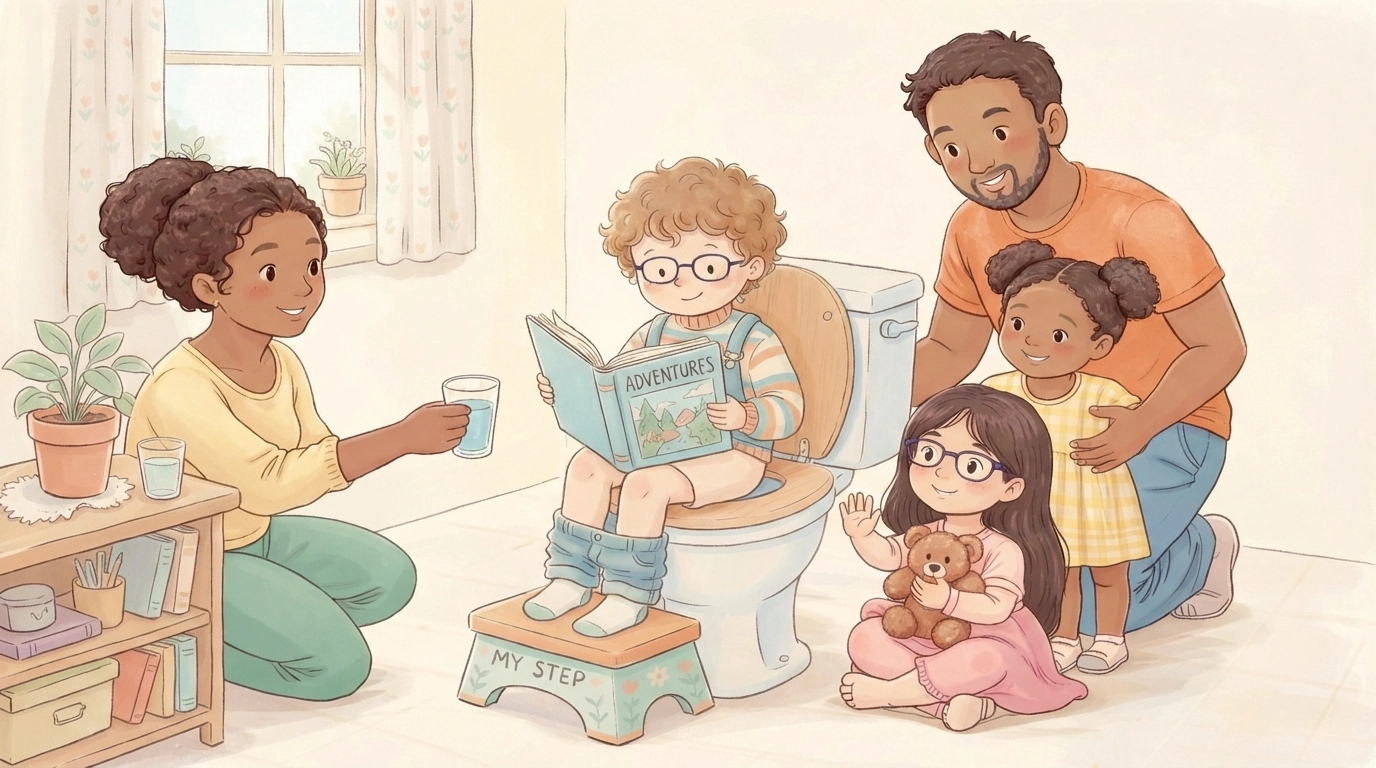
2. Build a “Poop-Friendly” Toilet Setup (Position matters more than you think)
Kids aren’t small adults. Their feet often dangle on a standard toilet—which makes it harder to relax the pelvic floor.
What helps:
- a footstool so knees are slightly higher than hips
- a calm posture: elbows on knees, belly relaxed
- “blow out candles” breathing (slow exhale helps pelvic floor drop)
This isn’t about forcing poop. It’s about making the body feel safe enough to release.
3. Establish a Relaxed Toilet Routine (Use your child’s natural reflexes)
Encourage your child to sit on the toilet after meals (especially breakfast and dinner) for 5–10 minutes. No pressure. No rushing. Just a calm, consistent opportunity for the body to do its job.
Why after meals? Because of the gastrocolic reflex—your gut naturally wakes up and moves things along when food hits the stomach.
Parent tip: keep it neutral and predictable:
- “We do a quick sit after breakfast.”
- not: “You HAVE to poop.”
4. Watch for Incomplete Emptying (Both pee and poop)
If your child “goes” but seems to leave a lot behind, that’s worth noting. Some kids rush. Some brace. Some hold because it hurts.
Clues of incomplete emptying:
- back-to-back bathroom trips
- “I just went!” but urgency returns fast
- tiny pees all day
- accidents shortly after using the toilet
A pediatric pelvic floor therapist can help identify holding patterns, coordination issues, or tension that keeps the rectum/bladder from emptying well.
5. Don’t ignore daytime bladder habits (they can drive nighttime trouble)
Bedwetting rarely exists in a vacuum. Support the whole system:
- pee every 2–3 hours (gentle reminders, not nagging)
- take time to fully empty (count to 10, “double void” if recommended)
- avoid chronic “just-in-case” pees every 20 minutes (can train a smaller capacity)
6. When food + routine isn’t enough: loop in your provider early
Sometimes constipation needs medical support—especially when there’s long-standing stool retention, painful stools, or overflow smearing.
Talk to your child’s provider about:
- whether stool softeners or osmotic laxatives are appropriate
- how long a plan should be followed (many kids need longer than parents are told)
- whether imaging or a structured bowel program is indicated
And yes—a simple abdominal X-ray can sometimes show stool load that isn’t obvious from symptoms alone.
This isn’t about “medicating your way out.” It’s about restoring normal size and function so the bladder can finally do its job.
A Note About Shame (Please Read This)
Before we close, I need to say something important.
If your child has been wetting the bed: and constipation turns out to be part of the puzzle: this is not a reflection of your parenting.
You didn't cause this by missing something.
You didn't fail by not knowing.
This connection is underdiagnosed and underexplained, even in medical settings. The fact that you're here, reading this, looking for answers?
That's not failure. That's fierce love in action.
Your child is not broken. Their body is simply learning: and sometimes it needs a little help.
The Takeaway (Still Simple—Just More Supported)
Constipation and bedwetting are more connected than most families realize.
A full rectum can press on the bladder, reduce its capacity, and trigger nighttime accidents—even in children who seem to have “normal” bowel habits.
Treating constipation often leads to significant improvement in bedwetting, sometimes within weeks. And even when bedwetting has multiple causes, addressing constipation is often the foundational move that helps everything else work better.
And most importantly:
This isn't your fault. And it isn't your child's either.
There is a way forward—and it doesn’t involve shame. It involves support, strategy, and small daily habits that add up to a big win.
Ready to Take the Next Step?
If you're looking for a structured, supportive approach to help your child build healthy bladder and bowel habits: without the stress: explore our Bladder Breakthrough programs designed by a pediatric pelvic floor expert.
You don't have to figure this out alone.
References:
- Hodges, S.J., et al. (2012). Journal of Urology
- Burgers, R., et al. Journal of Pediatric Urology
- American Academy of Pediatrics (AAP)
- International Children's Continence Society (ICCS)