
Your Quick-Start Guide to Bladder Training for Kids: Do This First

You've tried the gentle reminders. The reward charts. The waterproof mattress protectors. Maybe you've even invested in pull-ups that your pediatrician swore your child would "grow out of." But here you are, laundry piling up, accidents happening at the worst possible moments, and that familiar knot of worry settling in your chest every time your child leaves for school.
Here's what nobody tells you: bladder training for kids isn't about waiting for their body to "catch up." It's not about hoping for a magical developmental switch to flip. It's about giving your child the right tools, at the right time, in the right order.
And if you're wondering where to start? There's one step that matters more than anything else, and most parents skip right over it.
Let me walk you through exactly what to do first, why it works, and how to avoid the mistakes that keep families stuck in the cycle of daytime wetting, nighttime accidents, and constant stress.
The Single Most Important First Step (That Everyone Overlooks)
If you take nothing else from this article, take this: establish a consistent bathroom schedule before you do anything else.
Not punishment. Not limiting fluids. Not waking your child up three times a night.
A simple, structured, time-based toileting routine is the foundation of successful bladder training for kids, and it's the one thing that will make everything else you try actually work.
Here's why: Most children with daytime wetting or bedwetting issues aren't dealing with a broken bladder. They're dealing with a bladder that never learned proper timing, emptying patterns, or self-regulation. Their bladder sends signals too late, too urgently, or not at all. They're either too busy playing to notice the urge, or they've learned to ignore it until it's an emergency.
Scheduled voiding puts your child back in control. Instead of waiting for the bladder to dictate when they go (usually when it's too late), you're teaching the bladder to work on their schedule.
Research consistently shows that timed voiding, taking bathroom breaks every 2-3 hours whether your child feels the urge or not, is one of the most effective behavioral interventions for pediatric incontinence. It reduces accidents, decreases urgency episodes, and helps retrain the bladder-brain connection that's gone a little haywire.
And the best part? You can start today. Right now. No special equipment needed.

How to Set Up a Bathroom Schedule That Actually Works
Let's get practical. Here's your step-by-step guide to building a bladder training schedule that fits your family's life:
Step 1: Pick Your Times
Start with bathroom breaks every 2-3 hours during waking hours. That usually means:
- First thing in the morning (right after waking up)
- Mid-morning (around 10 a.m.)
- Before or after lunch
- Mid-afternoon (around 3 p.m.)
- Before dinner
- Before bath/bedtime routine
If your child is younger or has more frequent accidents, start with every 2 hours. If they're older with good control most of the time, 3-hour intervals work well.
Pro tip: Set alarms on your phone or use a visual timer your child can see. Make it fun, pick a silly ringtone or let them choose a song. The goal is consistency, not perfection.
Step 2: Make It Non-Negotiable (But Not Punishing)
This is where parents struggle. You send your child to the bathroom, and they say, "But I don't have to go!"
Your response? "I know, buddy. But it's bathroom time. We're training your bladder to be super strong. Let's just try."
They don't have to feel the urge. That's the whole point. You're teaching the bladder to empty regularly before it gets overfull and starts leaking. You're preventing accidents instead of reacting to them.
Keep it matter-of-fact. No lectures. No frustration. Just a calm, consistent routine that becomes as automatic as brushing teeth.
Step 3: Track It
Use a simple chart, stickers, checkmarks, stamps, whatever your child likes. Every successful bathroom visit gets marked. This isn't about rewards or punishment; it's about creating visual proof of progress and building intrinsic motivation.
You can also track accidents separately (we recommend a bladder diary, more on that later) so you can identify patterns and adjust timing as needed.

The Hydration Paradox: Why Your Child Needs to Drink More, Not Less
I know what you're thinking. If my child drinks less, they'll pee less, right?
Wrong. And dangerous.
Restricting fluids is one of the most common mistakes parents make when trying to help a child with daytime accidents or bedwetting, and it backfires spectacularly.
Here's what happens: When your child doesn't drink enough water, their urine becomes concentrated. Concentrated urine irritates the bladder lining, which triggers urgency and frequency. Your child suddenly has to go more often, with less warning, and the accidents actually increase.
Plus, dehydration contributes to constipation (which we'll get to in a minute), and constipation is the silent saboteur behind nearly 80% of pediatric bladder issues.
Your child needs 4-6 glasses (8 oz each) of fluids daily. Focus on water and milk. Skip the juice boxes, sodas, and anything with caffeine or artificial sweeteners, they're bladder irritants that make urgency worse.
Timing matters, too. Front-load hydration during the day. Most fluids should be consumed before 6 p.m. to reduce nighttime bladder volume. But don't cut off liquids entirely, your child should still have access to water in the evening if they're thirsty.
The Bathroom Position That Changes Everything
You wouldn't try to empty a water bottle while holding it upside down, right? Same concept applies to your child's bladder.
Proper positioning during urination is critical for complete bladder emptying, and most kids are doing it wrong.
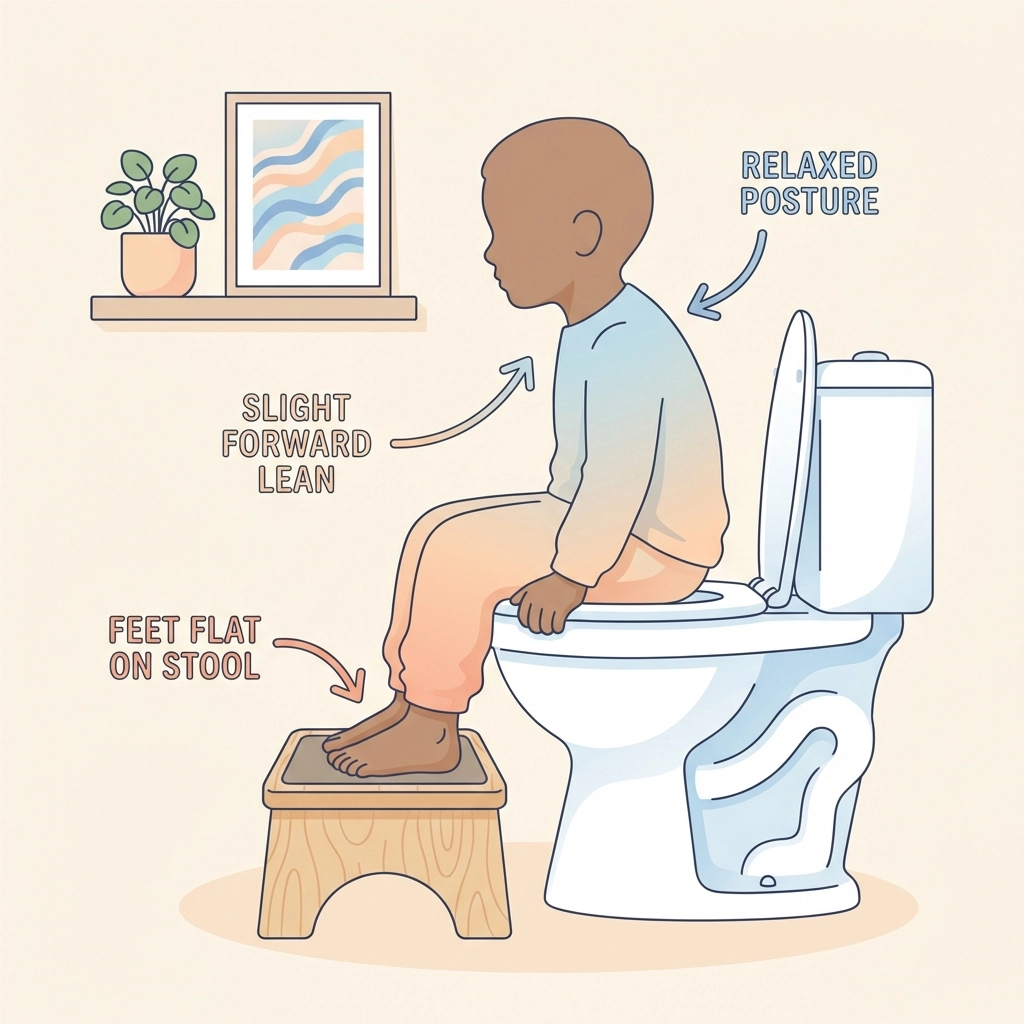
Here's what correct toileting posture looks like:
- Feet flat on the floor (or on a sturdy step stool if your child's legs don't reach)
- Knees spread apart slightly
- Leaning slightly forward (this relaxes the pelvic floor muscles)
- No straining or pushing
If your child's feet are dangling, their pelvic floor stays tense, which blocks complete emptying. If they're hunched over a phone or tablet, same problem. And if they're hovering over a public toilet seat? Forget it, they're definitely not emptying fully.
Give them 3-5 minutes per bathroom visit. Rushing leads to incomplete emptying, which leads to residual urine, which leads to urgency and accidents an hour later.
Teach your child to take 3-4 deep breaths while sitting on the toilet. Deep breathing activates the relaxation response and helps the sphincter muscles release naturally. It's one of the foundational pediatric pelvic floor exercises we use in clinical practice, and it's something you can start at home today.
The Double Void Trick (That Pediatric PTs Swear By)
Once your child finishes urinating, have them:
- Stand up
- Wash their hands
- Return to the toilet and try again
This is called double voiding, and it's a game-changer for kids who deal with frequent urgency or post-void dribbling.
Why does it work? Sometimes the bladder doesn't empty completely on the first try, especially if your child is rushing, distracted, or their pelvic floor muscles are a little too tight. By taking a short break and trying again, you give the bladder a second chance to fully empty.
Think of it like wringing out a sponge. One squeeze gets most of the water out, but a second squeeze gets it all.
Double voiding reduces the amount of residual urine left in the bladder, which means fewer accidents, less urgency, and longer stretches between bathroom visits.
Why Constipation Is Your Bladder Training Enemy #1
Let's talk about something you might not connect to bladder issues: poop.
Constipation and bladder dysfunction are so closely linked that we can't treat one without addressing the other. Here's why:
Your child's bladder and rectum share a very small space in the pelvis. When the rectum is full of stool (even if your child is pooping every day, hard, pellet-like poops still count as constipation), it presses directly on the bladder. This:
- Reduces bladder capacity
- Triggers urgency
- Blocks complete emptying
- Interferes with nerve signals
Studies show that up to 80% of children with daytime wetting have underlying constipation, and many parents don't even realize it.
Signs your child might be constipated:
- Pooping less than once per day
- Hard, painful, or pellet-like stools
- Straining on the toilet
- Stomachaches or bloating
- Withholding behaviors (dancing, squeezing legs together, hiding)
How to fix it: Increase dietary fiber (fruits, vegetables, whole grains), boost water intake, and add a daily probiotic if needed. If constipation persists, talk to your pediatrician about a gentle stool softener like MiraLAX.
You won't see bladder training progress until you address the constipation. Full stop.
Common Bladder Training Mistakes (And How to Avoid Them)
Let me save you some time and frustration. Here are the mistakes I see parents make over and over, and how to course-correct:
Mistake #1: Waiting for your child to "tell you when they need to go"
If your child had reliable urge awareness, you wouldn't be here. Scheduled voiding eliminates the need for them to recognize the urge every time.
Mistake #2: Punishing accidents
Shame doesn't teach bladder control. It teaches fear and secrecy. Keep your response neutral: "Oops, accident. Let's clean up and try again next time."
Mistake #3: Starting with nighttime training first
Daytime control almost always has to come before nighttime dryness. Master the daytime schedule first, then tackle nights.
Mistake #4: Quitting too soon
Bladder retraining takes 4-6 weeks minimum. You won't see overnight results, but you will see progress if you stay consistent.
Mistake #5: Skipping the bladder diary
You can't fix what you can't see. Track fluid intake, bathroom times, and accidents for at least 3 days to identify patterns. (Need help with this? Our Stay Dri 5-Day Bladder Breakthrough Challenge walks you through exactly how to do this.)

What If Bladder Training Isn't Enough?
Here's the thing: Behavioral strategies like scheduled voiding, proper hydration, and positioning work beautifully for many kids. But not all kids.
If you've been consistent with bladder training for 6-8 weeks and you're still seeing frequent accidents, nighttime wetting, or severe urgency, it's time to dig deeper.
Your child might benefit from:
- Pelvic floor physical therapy to address muscle coordination issues
- Biofeedback training to help them "see" what their bladder is doing
- Bladder retraining with gamification (hello, Bladder Defender EduPlay™ app): kids learn better when they're having fun
- Medical evaluation to rule out anatomical issues, UTIs, or overactive bladder
That's where we come in. At Bladder Breakthrough, we've built an entire system around making bladder training effective, engaging, and actually doable for real families juggling school, activities, and daily chaos.
Our approach combines clinical-grade pelvic floor exercises, personalized bladder diaries, and gamified learning tools that kids genuinely enjoy using. Because let's be honest: no child wants to do "bladder exercises." But they'll absolutely play a game where they're a superhero saving the day, one bathroom break at a time.
If you're ready to stop guessing and start seeing results, check out our virtual course or explore our VIP Concierge Experience for one-on-one support.
Your Next Steps: The Quick-Start Checklist
Ready to get started? Here's your action plan for the next 7 days:
✅ Day 1-2: Set up your bathroom schedule. Pick your times, set alarms, and start tracking with a simple chart.
✅ Day 3-4: Focus on hydration. Count those glasses and front-load fluids before dinner.
✅ Day 5-6: Work on positioning and relaxation. Feet flat, knees apart, deep breaths, double void.
✅ Day 7: Evaluate constipation. Is poop a problem? Address it now.
✅ Ongoing: Keep a bladder diary for at least one week to identify patterns and adjust your approach.
One more thing: Progress isn't linear. You'll have great days and tough days. Accidents will still happen: especially during transitions, growth spurts, or stressful periods. That's normal. What matters is the overall trend, not individual setbacks.
You're teaching your child a skill that will serve them for life. And you're doing it with patience, consistency, and love: even on the days when you're exhausted and out of clean sheets.
That's not just bladder training. That's parenting at its finest.
References & Further Reading
- Chase, J., Austin, P., Hoebeke, P., & McKenna, P. (2010). The management of dysfunctional voiding in children: A report from the Standardisation Committee of the International Children's Continence Society. Journal of Urology, 183(4), 1296-1302.
- Hodges, S. J., & Anthony, E. Y. (2012). Occult megarectum in children with nocturnal enuresis. Journal of Urology, 187(5), 1870-1873.
- Franco, I. (2011). Overactive bladder in children. Part 1: Pathophysiology. Journal of Urology, 186(4), 1163-1168.
- Vande Walle, J., Rittig, S., Bauer, S., Eggert, P., Marschall-Kehrel, D., & Tekgul, S. (2012). Practical consensus guidelines for the management of enuresis. European Journal of Pediatrics, 171(6), 971-983.
- Burgers, R., Mugie, S. M., Chase, J., Cooper, C. S., von Gontard, A., Rittig, C. S., ... & Benninga, M. A. (2013). Management of functional constipation in children with lower urinary tract symptoms: Report from the Standardization Committee of the International Children's Continence Society. Journal of Urology, 190(1), 29-36.
Want more guidance on helping your child with daytime accidents? Explore our complete library of resources at Bladder Breakthrough or get in touch with our team through our contact page. We're here to help you and your child win.