
The Self-Esteem Solution: Building Confidence While Your Child Still Wets the Bed

The Silent Struggle No One Talks About
Let's be honest, when your child wets the bed, your brain immediately goes to the logistics. The sheets. The mattress protector. The 2 AM laundry shuffle. But here's what keeps parents up at night long after the washing machine stops spinning: What is this doing to my child's heart?
You've seen it, haven't you? The way your kiddo's shoulders slump when they wake up wet. The quiet shame in their eyes. The way they suddenly "don't feel like" going to that birthday sleepover.
Here's the truth bomb I want you to catch: Bedwetting isn't just a laundry problem, it's an emotional one. And if we're going to truly solve it, we need to address both the bladder and the belief system your child is building about themselves.
The good news? You have more power than you realize to protect and build your child's self-esteem while their body catches up. That's exactly what we're diving into today.
The Science of Self-Esteem: What Research Tells Us
Before we get into the "how," let's talk about the "why this matters so much."
Studies consistently show that children who experience nocturnal enuresis (that's the fancy term for bedwetting) have measurably lower self-esteem than their dry peers. We're talking about a 10% or greater dip in self-esteem scores, and that gap widens the longer bedwetting continues without supportive intervention.
Research published in the Journal of Urology found that the psychological burden of bedwetting can be comparable to chronic conditions like asthma or diabetes. Let that sink in. Your child isn't being "dramatic", their distress is real, measurable, and valid.
The Stress-Bladder Connection
Here's where it gets really interesting: stress doesn't just result from bedwetting, it can actually make bedwetting worse.
When a child feels anxious or ashamed, their body releases cortisol (the stress hormone). Elevated cortisol can:
- Disrupt sleep architecture, making it harder for the brain to "hear" the bladder's full signal
- Increase nighttime urine production
- Create a feedback loop where stress → wet nights → more stress → more wet nights
This is why shame-based approaches don't just fail emotionally, they fail physiologically. We have to break that cycle, and it starts with how we talk about bedwetting in our homes.

The "No-Blame" Language Revolution
Words matter. A lot. The language you use around bedwetting shapes how your child sees themselves, and whether they believe this is something they are or something they're working through.
Scripts for Success
Here are some powerful language swaps to start using today:
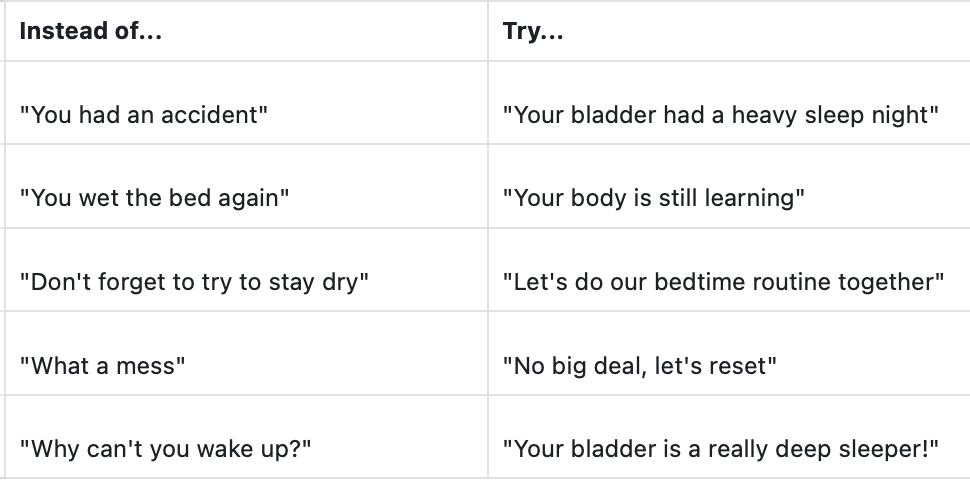
The magic phrase I want you to memorize:
> "Your bladder is just a deep sleeper, like a bear in hibernation! It's still learning to send a wake-up call to your brain."
This reframe does something crucial: it separates your child's identity from their bladder's behavior. They're not "a bedwetter." They're a kid with a bladder that's still leveling up.
What to Avoid
- Never use bedwetting as a punchline, even gently
- Never discuss their bedwetting in front of siblings, friends, or extended family without explicit permission
- Never compare them to other children ("Your sister was dry by 5!")
- Never frame dry nights as the only measure of success
The Team Approach: Us vs. The Bedwetting
One of the most powerful psychological shifts you can make is moving from an adversarial dynamic to a collaborative one.
It's not Parent vs. Child (where you're trying to "fix" them).
It's Team Family vs. The Sleepy Bladder (where you're allies fighting together).
This might sound like:
- "We're going to figure this out together."
- "I'm on your team, and we've got some cool strategies to try."
- "This is something that's happening to you, not something you're doing wrong."
When children feel like they're part of the solution, not the problem to be solved, their motivation and confidence skyrocket.

Building Your "Stay Dry Squad"
At Bladder Breakthrough, we've gamified this team approach with our Stay Dry Squad characters. Kids get to choose their avatar and earn "Power-Ups" for completing healthy habits. It transforms the whole experience from something shameful into something... dare I say... fun?
Because here's the secret: kids don't resist change, they resist boring change. Make it an adventure, and suddenly they're all in.
Empowerment & Agency: The Power-Up Protocol
Nothing builds self-esteem faster than feeling capable. And the best way to help a child feel capable is to give them age-appropriate ownership over their journey.
Power-Ups They Can Control
Instead of focusing only on dry nights (which are largely out of their conscious control), celebrate habits and efforts they can control:
Morning Power-Ups:
- 🌟 Helping strip the bed and put sheets in the hamper
- 🌟 Taking a quick morning shower independently
- 🌟 Choosing their own "fresh start" outfit
Daytime Power-Ups:
- 💧 Hitting their hydration goals (front-loading fluids!)
- 💪 Completing TheraPlay exercises or EduPlay drills
- 🚽 Practicing double-voiding before bed
Bedtime Power-Ups:
- 🦸 Picking out their "hero" pajamas
- ✅ Running through the bedtime checklist themselves
- 📝 Logging their progress in their tracker
The Reward Revolution
Here's a game-changer: reward the effort, not just the outcome.
Traditional approaches often reward dry nights, which can backfire spectacularly when a child does everything "right" and still wakes up wet. The message they receive? "My effort doesn't matter."
Instead, create a reward system around completed habits:
- Did they drink water throughout the day? Point!
- Did they do their double-void? Point!
- Did they help with the morning reset without complaint? BONUS POINT!
Our virtual course includes customizable reward trackers that make this system easy to implement, and actually exciting for kids.

Handling the "Social Sting"
Let's address the elephant in the room: other kids can be... not great about differences. And siblings? Don't even get me started.
When Siblings Ask Questions
Keep it simple, matter-of-fact, and boring:
"Everyone's body develops at different speeds. Sam's bladder is still learning to stay dry at night. It's not a big deal, and it's private, just like lots of things about our bodies."
The key is to not make it A Thing™. The more drama-free your response, the more drama-free their perception becomes.
Protecting Privacy
Your child gets to decide who knows. Period. This means:
- Not mentioning it to grandparents, teachers, or other parents without your child's permission
- Giving them cover stories for sleepovers if they want them
- Respecting closed bathroom doors
For sleepover strategies that actually work, check out our guide on Sleepovers and Sleepaway Camp.
When Someone Says Something Hurtful
Prepare your child with a simple, confident response they can use:
"Yeah, sometimes bodies take longer to learn stuff. No big deal."
Then move on. The less power they give the comment, the less power it has.
The "Dry Run" of Confidence: Positive Self-Talk Practice
Here's something most parents don't think about: you can actually rehearse confidence.
Just like athletes visualize success before a big game, your child can practice positive self-talk about their bedwetting journey. This isn't woo-woo stuff: it's backed by cognitive behavioral research.
Affirmations That Actually Work
Help your child choose 2-3 statements that resonate with them:
- "My body is still learning, and that's okay."
- "Wet nights don't define me."
- "I'm doing my part, and my bladder is catching up."
- "I'm brave enough to keep trying."
- "Every superhero has challenges: this is mine."
Practice these during calm moments: maybe as part of the bedtime routine or during car rides. The goal is for these thoughts to become automatic, replacing the shame script with a strength script.
> Power Line: Your child is not their wet bed. They are a hero-in-training who just happens to have a sleepy bladder.

Your Questions, Answered (Q&A)
"When will my child grow out of bedwetting?"
Most children naturally achieve nighttime dryness between ages 5-7, but up to 15% of 6-year-olds and 5% of 10-year-olds still experience bedwetting. The average spontaneous resolution rate is about 15% per year: meaning each year, roughly 15% of bedwetting children will become dry without intervention. However, waiting isn't your only option. Evidence-based approaches like bladder training, alarm therapy, and hydration optimization can significantly accelerate this timeline.
"Is my child wetting the bed because of anxiety?"
While anxiety doesn't typically cause primary bedwetting (bedwetting that's been present since birth), it can absolutely make it worse: and bedwetting can certainly cause anxiety, creating a vicious cycle. If your child's bedwetting began after a period of dryness (called secondary enuresis), emotional factors like stress, trauma, or major life changes should definitely be explored with your pediatrician.
"How do I help my child not feel ashamed of bedwetting?"
The biggest factor is your response. Children take emotional cues from their parents. If you treat bedwetting as a neutral, solvable challenge rather than a moral failing, your child will internalize that framework. Use no-blame language, celebrate effort over outcomes, protect their privacy fiercely, and remind them frequently that this is about their body learning: not about who they are as a person.
"What are the psychological effects of bedwetting on an 8-year-old?"
Research shows that 8-year-olds with bedwetting may experience lower self-esteem, social anxiety, fear of discovery, avoidance of social activities like sleepovers, and in some cases, symptoms of depression. The good news? Studies consistently show that these psychological effects improve significantly with successful treatment and supportive parenting. Addressing bedwetting proactively isn't just about dry sheets: it's about protecting your child's developing sense of self.
The Bottom Line
Your child's bedwetting journey doesn't have to be a story of shame. With the right language, the right mindset, and the right tools, it becomes a story of resilience, teamwork, and triumph.
You're not just waiting for their bladder to mature: you're actively building a foundation of confidence that will serve them for life. Every time you respond with compassion instead of frustration, every time you celebrate effort over outcome, every time you remind them that their worth isn't measured in dry nights... you're doing the real work.
Ready to turn this challenge into your family's breakthrough moment? Explore our 5-Day Challenge to get started with a proven, gamified approach that kids actually love: and that builds confidence from day one.
Your child is capable. Your child is worthy. And together? You've got this. 💪
References & Further Reading
Medical & Research Sources:
- Theunis, M., et al. (2002). "Self-image and performance in children with nocturnal enuresis." European Urology, 41(6), 660-667.
- Joinson, C., et al. (2007). "Psychological problems in children with bedwetting and combined (day and night) wetting: A UK population-based study." Journal of Pediatric Psychology, 32(5), 605-616.
- American Academy of Pediatrics. (2023). "Bedwetting in Children & Teens: Nocturnal Enuresis." HealthyChildren.org.
- Urology Care Foundation. (2024). "What is Bedwetting (Nocturnal Enuresis)?" UrologyHealth.org.
- Nevéus, T., et al. (2020). "Management and treatment of nocturnal enuresis: an updated standardization document." Journal of Pediatric Urology, 16(1), 10-19.
- Van Hoeck, K., et al. (2007). "Do psychological effects of bedwetting improve with treatment?" Pediatric Nephrology, 22(8), 1211-1219.
Bladder Breakthrough Resources: