

Welcome to the kitchen, friend. Pull up a chair.
If you're here, you're probably juggling a million things, work, school schedules, laundry piles that seem to multiply overnight, and somewhere in the middle of all that chaos, you're also trying to figure out how to stop bedwetting in your child. And now someone's telling you that food plays a role too?
Deep breath. I've got you.
Here's the good news: this isn't about perfection. It's not about overhauling your entire pantry or becoming a short-order cook. It's about understanding that what goes into your child's body can either calm the bladder or irritate it, and making a few bladder-smart food swaps that actually fit into real life.
We're fueling the body and calming the bladder, one bite at a time.
Let's dig in.
What Are Bladder Irritants? (And Why They Matter)
Think of your child's bladder like a calm little pond. When everything is balanced, the water is still and peaceful. But certain foods and drinks? They're like tossing pebbles into that pond—creating ripples, waves, and a whole lot of unnecessary activity.
We call these bladder irritants, and they can make the bladder feel “twitchy,” urgent, or just plain extra. For kids who are already working on nighttime potty training or dealing with bedwetting in children, irritants can crank up the signals (urgency + frequency) and make dryness feel harder than it needs to be.
Here’s the science-y but parent-friendly version of what’s happening:
- The bladder is lined with a protective layer (think: a slippery raincoat). In sensitive kiddos, certain foods/drinks can make that lining feel “raw” or reactive—so the bladder sends “GO NOW!” signals even when it’s not that full.
- Some ingredients increase urine production (diuretic effect) so the bladder fills faster.
- Acidic or spicy foods can sensitize nerves in the bladder and pelvic region—so the “alarm system” goes off sooner.
- Sugar and high-osmolar drinks (very concentrated juices/sports drinks) can pull water into the gut, increase thirst, and sometimes lead to bigger evening drinking—aka more nighttime output.
None of this means your child is doing anything wrong. It means their body is getting louder messages than it needs to.
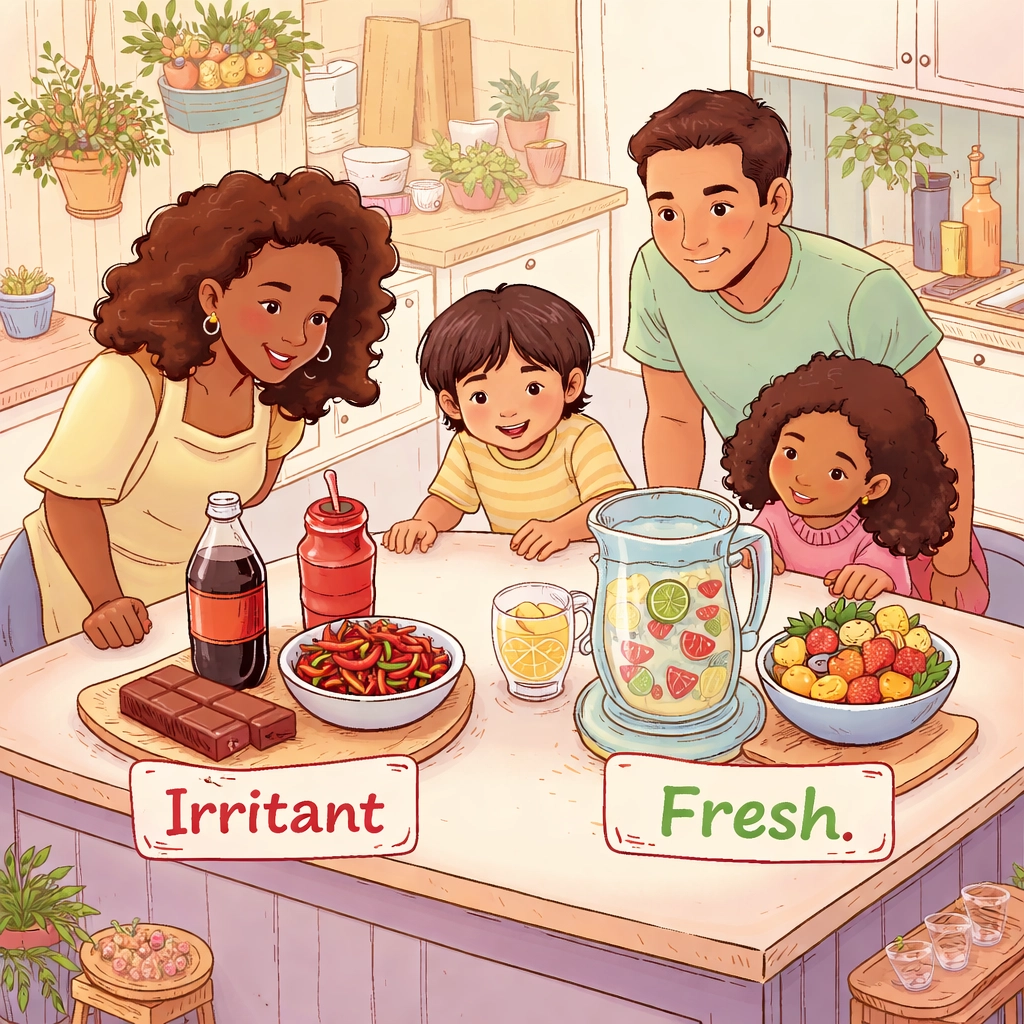
The Usual Suspects: Foods & Drinks That Can Irritate
Here’s the lineup of common bladder irritants to keep an eye on—plus more specific examples so you’re not left guessing in the grocery aisle.
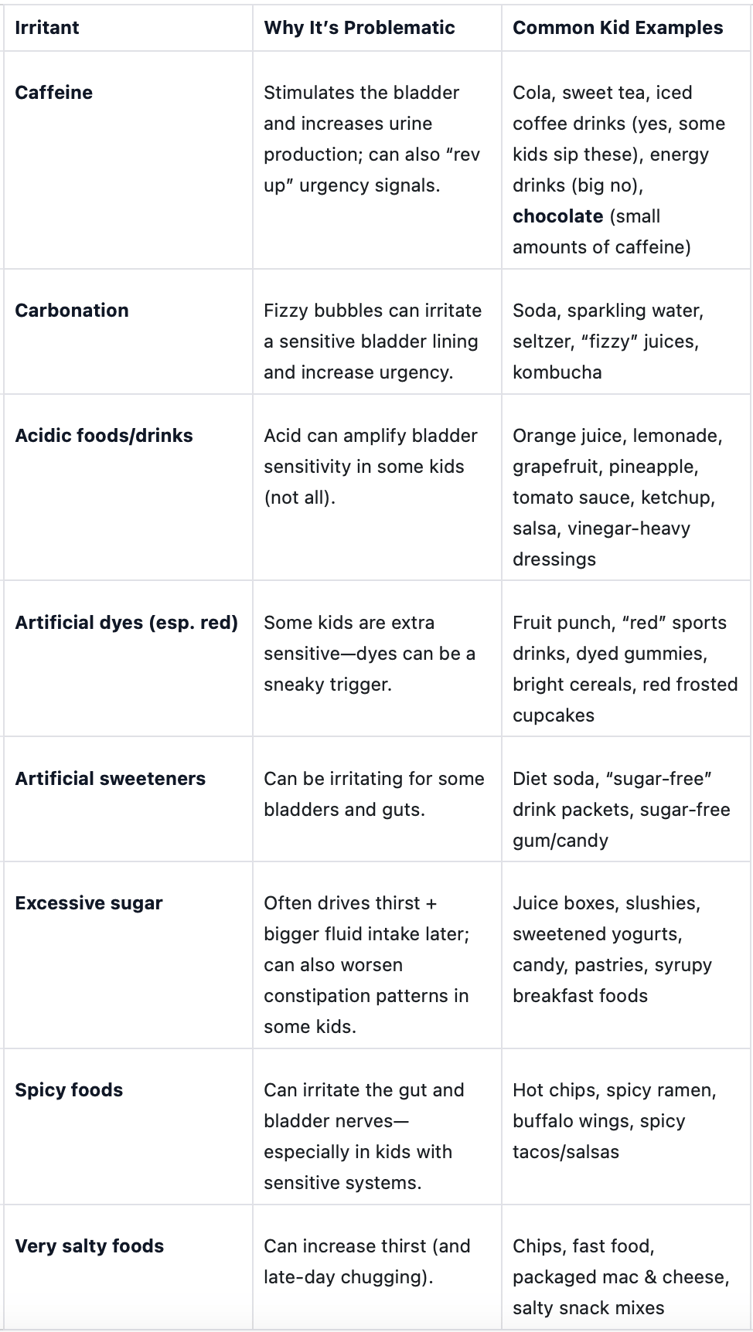
Now, I’m not saying you need to ban birthday cake or make your child the only one at the party drinking plain water. Life is meant to be lived. But awareness is power—especially on school nights, before sleepovers, or during a stretch when accidents are flaring.
> Dr. T’s Pro Tip: When you see neon colors (especially reds and blues), pause. Those dyes are often hidden bladder irritants. Try infusing water with real fruit (pear slices, blueberries, cucumber) for a bladder-friendly win.
How to Tell If a Food Is a Trigger (Without Becoming a Food Detective 24/7)
You don’t need to cut everything at once. Use a simple “test-and-learn” approach:
- Pick one suspected irritant (like orange juice or soda).
- Remove it for 7–10 days (keep everything else mostly the same).
- Watch for changes in:
-
- urgency (“I have to go RIGHT NOW!”)
- frequency (going every 20–40 minutes)
- nighttime wetting volume
- tummy complaints or constipation
- Re-introduce once and see if symptoms pop back up within 24–48 hours.
This is how we keep it science-backed and realistic—no perfection required.
> Clinical note (kept simple): Pediatric bladder symptoms often improve when we reduce irritants and improve bowel habits. It’s not one magic food—it’s the whole system working together.
Bladder-Friendly Foods: What to Reach For
Okay, now for the fun part: let's talk about the bladder-smart foods that actually support your child's bladder health and overall nutritional needs. These are the MVPs of the bladder-smart kitchen.
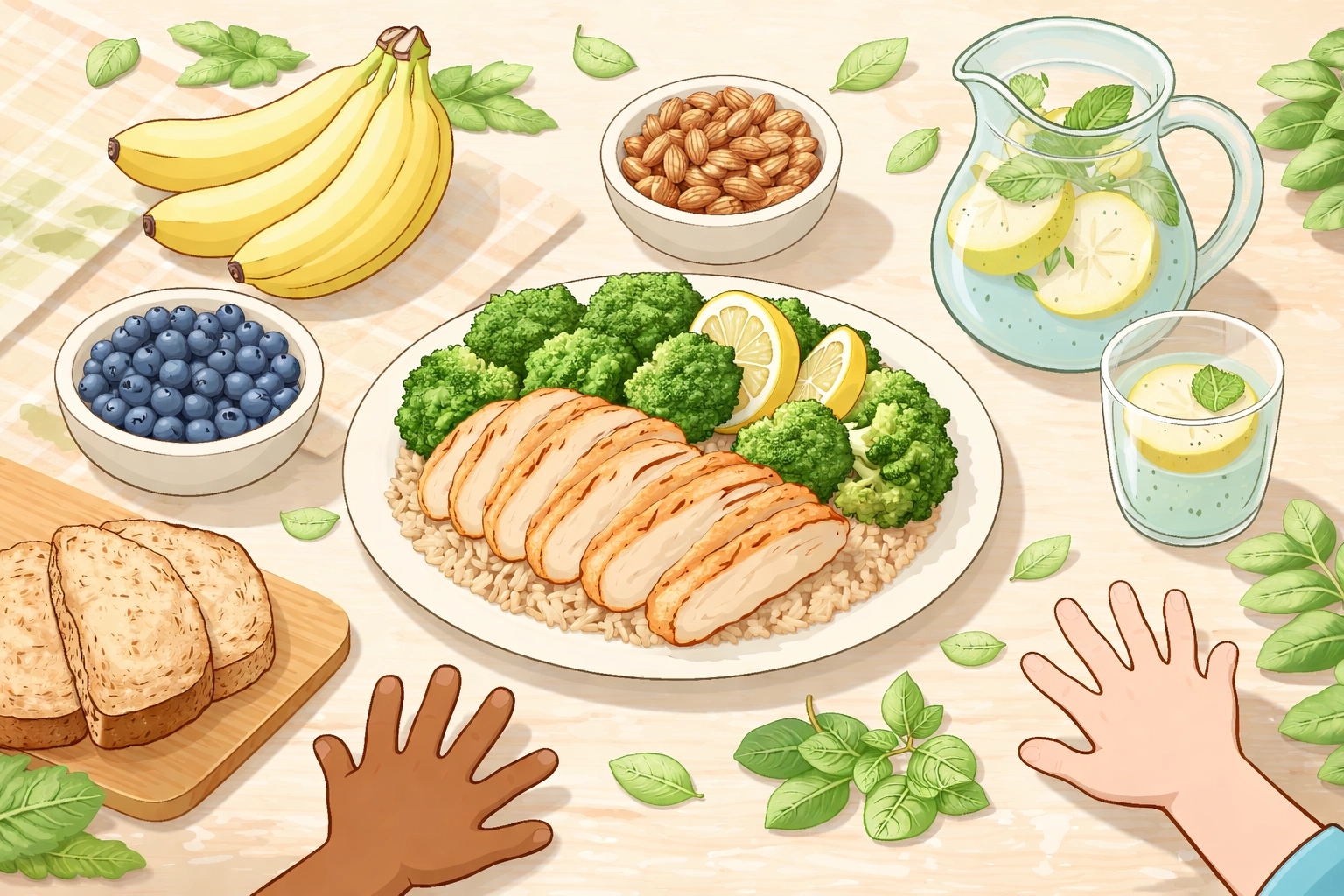
Lean Proteins
Chicken, turkey, fish, eggs, and lean cuts of beef and pork are all excellent choices. They're gentle on the bladder and provide the protein growing bodies need. Baking, steaming, or broiling these proteins keeps them bladder-friendly (deep-frying with heavy seasonings? Not so much).
Non-Citrus Fruits
Skip the orange juice and reach for:
- Bananas – A potassium powerhouse that's gentle on the bladder
- Blueberries – Packed with antioxidants and naturally low in irritants
- Pears – Sweet, hydrating, and bladder-approved
- Melons – Watermelon, cantaloupe, and honeydew are all great choices
Cruciferous Vegetables & More
Load up on:
- Broccoli
- Cauliflower
- Carrots
- Green beans
- Squash
- Cabbage
These veggies contain anti-inflammatory compounds that can actually help reduce irritation throughout the urinary tract. Plus, they're fiber superstars: and fiber is about to become your new best friend.
Whole Grains
Rice, oats, quinoa, and whole-grain bread and pasta provide sustained energy without irritating the bladder. They're also fantastic sources of fiber.
Healthy Nuts
Almonds, cashews, and macadamia nuts make great bladder-friendly snacks. They're protein-rich, satisfying, and won't send the bladder into overdrive.
The Fiber Factor: Why Constipation Is the Bladder's Worst Neighbor
Here’s something I wish every parent learned on day one: the bladder and the bowel are neighbors—and they share nerves, muscles, and limited space in your child’s pelvis. When the bowel is backed up, the bladder almost always pays the price.
When your child is constipated, that stool can sit and stretch the rectum like an overfilled suitcase. That creates a chain reaction:
- Mechanical pressure: A full rectum can literally push on the bladder, shrinking how much urine the bladder can comfortably hold.
- Mixed-up signals: The bowel and bladder “talk” through shared nerve pathways. When the bowel is irritated or stretched, it can turn up urgency signals to the bladder.
- Incomplete emptying: Constipation can interfere with pelvic floor coordination. Some kids rush, tense, and don’t empty fully—so they feel like they have to go again 20 minutes later.
- Nighttime consequences: If a bladder is already “working with less space,” nighttime urine production can overflow that reduced capacity—hello, bedwetting.

Think of it like this: if you're trying to fill a balloon but someone’s squeezing it from the outside, it’s going to overflow way sooner than it should. That’s exactly what constipation does to the bladder.
> Dr. T truth-bomb: If we don’t address constipation, many bladder plans stall out. Not because you failed—because the system is jammed.
“But My Kid Poops Every Day…” (Why That Still Might Be Constipation)
This surprises parents all the time: daily poop doesn’t automatically mean the bowel is fully empty. Some kids pass small amounts daily but still retain stool (we call this stool burden). Signs that constipation might still be in the picture:
- stools that are hard, pebbly, or painful to pass
- “skid marks” in underwear
- belly bloating, gas, or frequent tummy aches
- very large stools that clog the toilet
- avoidance behaviors (hiding, stiffening, tiptoe clenching)
- frequent urination or urgency with small pees
- bedtime becoming a “potty parade”
If you’re seeing these, constipation support isn’t optional—it’s strategic.
Fiber + Fluid = The Power Duo (And Why Fiber Alone Can Backfire)
Fiber is incredible, but here’s the deal: fiber needs water. If you increase fiber without enough daytime hydration, stool can become bulkier but still dry—and that can worsen constipation.
So our goal is a simple combo:
- steady fiber (food first)
- consistent water earlier in the day (we’ll talk timing next)
- plus regular bathroom routines (especially after meals)
How Fiber Helps the Bladder (Not Just the Gut)
Fiber supports the bladder in three big ways:
- Improves stool consistency (so there’s less “backlog pressure”)
- Promotes predictable bowel movements (less pelvic chaos)
- Supports healthy gut bacteria which can reduce inflammation and improve motility over time
Kid-Friendly Fiber Sources (With Super Specific Examples)
Here are realistic, kid-approved options—no “eat a bowl of plain beans” energy required.
Fruits (often easiest)
- pears (fresh, canned in water, or pureed)
- apples with skin (thin slices with nut/seed butter)
- berries (blueberries, raspberries—raspberries are fiber champs)
- prunes or prune puree mixed into yogurt or smoothies
- avocado (yes—fiber + healthy fats)
Veggies (stealth-friendly)
- carrots (roasted “fries,” shredded into meatballs)
- peas (mix into mac & cheese or rice)
- sweet potato (baked wedges, mashed, or blended into pancakes)
- spinach (smoothies, scrambled eggs, pasta sauce)
Whole grains
- oatmeal (add chia + blueberries)
- whole wheat pasta (with a mild cream sauce or olive oil + parmesan)
- brown rice or quinoa (use as “taco bowls”)
- whole grain bread, waffles, or wraps
Legumes (start small to avoid gas)
- hummus (dip + whole grain crackers)
- lentil pasta (kid-friendly texture, huge fiber bump)
- black beans blended into quesadillas or brownies (yes, it works)
Seeds (tiny but mighty—use safely)
- chia seeds (stir into yogurt, oatmeal, smoothies)
- ground flaxseed (sprinkle into pancake batter, muffins, oatmeal)
> Safety note: For younger kids, use ground flax/chia and ensure good hydration.
A Simple “Fiber Ladder” (So You Don’t Overwhelm a Picky Eater)
Level up gradually—this is how we win without battles:
- Level 1: add 1 fruit + 1 whole grain daily (pear + oatmeal)
- Level 2: add 1 veggie at dinner (peas in rice, carrots roasted)
- Level 3: add a seed booster 3–4x/week (chia in yogurt)
- Level 4: add legumes 2–3x/week (hummus, lentil pasta)
Small steps. Big payoff—less pressure, calmer bladder, fewer accidents.
Hydration: The Unsung Hero (When Timed Right)
Wait—if we’re trying to reduce nighttime accidents, shouldn’t we just cut fluids?
I hear this all the time, and I get it. It seems logical. But here’s the truth: over-restricting fluids can backfire.
When kids don’t drink enough during the day:
- urine becomes more concentrated (which can be more irritating)
- constipation risk goes up (and constipation squeezes the bladder—remember our “neighbors”)
- kids get “behind” on fluids and then chug later (after school / at dinner / before bed)
- the bladder doesn’t get consistent daytime practice filling and emptying
So instead of “less water,” we want smarter water.
The Bladder-Smart Hydration Strategy (Foundational Rules)
✅ Front-load fluids — Aim for most water in the morning and early afternoon
✅ Taper in the evening — Reduce (don’t eliminate!) fluids 1–2 hours before bed
✅ Choose water first — It’s the gold standard; minimize sugar, dyes, caffeine, carbonation
✅ Make it fun — A special bottle, a sticker tracker, fruit-infused “spa water”
> Power Move: Check out our deep dive on why hydration is the unsung hero in conquering pediatric incontinence for even more strategies!
Hydration Timing: A Bladder-Smart Day (Real-Life Schedule You Can Actually Use)
This is the missing piece for so many families: it’s not just how much your child drinks—it’s when they drink. Hydration timing helps you avoid the classic “dry all day, flood at night” pattern.
Here’s a simple rhythm that supports bladder training, bowel regularity, and nighttime dryness—without turning your kitchen into a hydration bootcamp.
Morning: “Prime the Pump” (Wake-Up → School Drop-Off)
Goal: Start the day hydrated so your child isn’t playing catch-up later.
- Right after waking: water with breakfast (a few big sips is a win)
- Potty sit #1: pee after waking (even if they “don’t have to go”)
- Breakfast pairing: fiber + fluid (oatmeal + berries, eggs + whole grain toast + pear)
> Why it works: Morning hydration supports regular bowel movement timing (many kids get the natural “gastrocolic reflex” after breakfast), which helps the bladder all day.
Mid-Morning: “Steady Sips” (School Hours)
Goal: Prevent concentrated urine and urgency spikes.
- send a bottle they can open easily (this matters more than you think)
- encourage a few sips at natural transitions: arrival, snack, recess, lunch
If your child avoids school bathrooms, hydration timing still matters—but we may need to pair it with bathroom confidence strategies (that’s a whole separate coaching convo).
Afternoon: “Rebuild After School” (Pickup → Dinner)
Goal: Catch up early, not at bedtime.
- After-school: 6–10 oz water (adjust to age/size/activity)
- Potty sit #2: pee after school (before homework/sports)
- for sports practice: water is usually enough; skip neon sports drinks when possible
> Parent reality check: After-school is when kids are thirsty and impulsive. If they don’t get water then, they’ll try to make up for it at dinner—then bedtime. We’re flipping that script.
Evening: “Taper, Don’t Panic” (Dinner → Bed)
Goal: Support comfort and routine without bedtime chugging.
- water with dinner is fine—just keep it reasonable
- aim to reduce big gulps about 1–2 hours before bed
- offer “sip-sized” water if they ask (we don’t want fear or restriction energy)
Bedtime: “Close the Loop” (The Dryness Routine)
Goal: Empty bladder fully before sleep.
- Potty sit #3: pee 20–30 minutes before bed
- Potty sit #4: pee right before lights out (“double void” for kids who rush)
- calm breathing can help pelvic floor relaxation (tension = incomplete emptying)
> Dr. T mantra: Sip. Pee. Reset. We’re building a system—not chasing accidents.
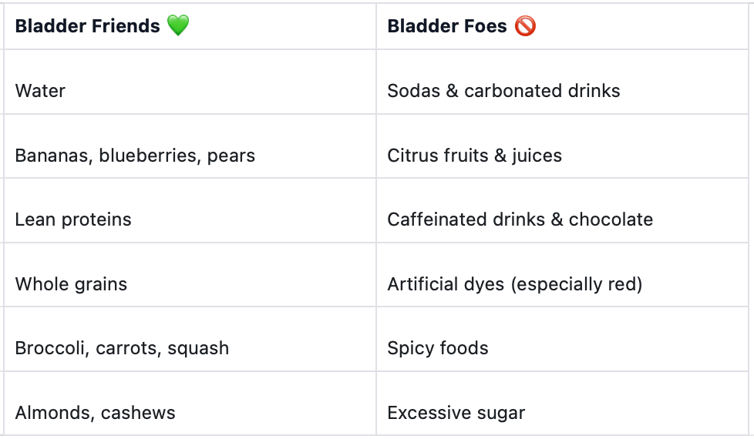
Your Bladder-Smart Kitchen Playbook
Feeling inspired? Here’s a quick-reference guide you can stick on your fridge:
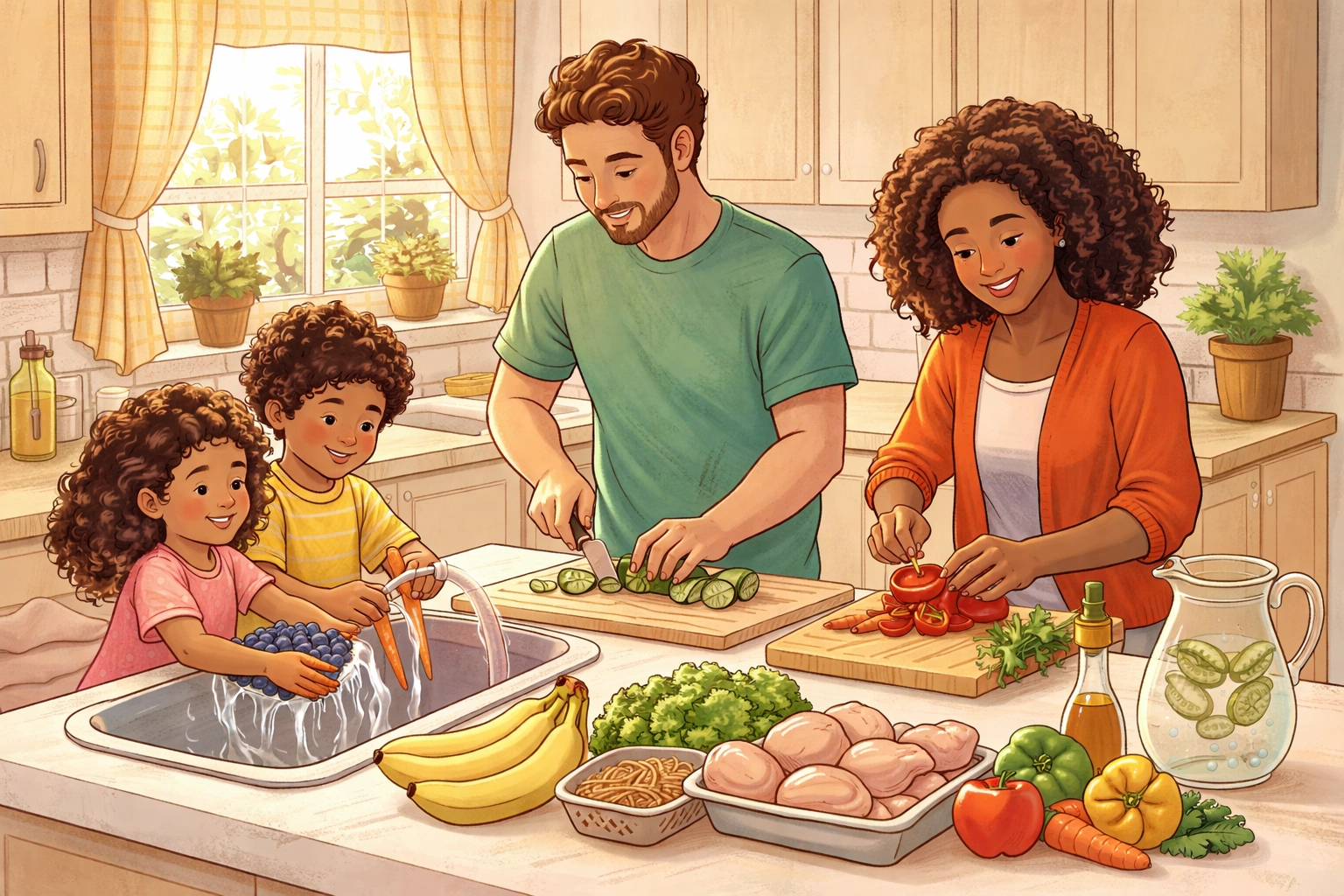
Kitchen Hacks for Parents: Make Bladder-Smart Eating Automatic (Not Another Chore)
You don’t need a Pinterest pantry. You need repeatable systems—because you’re already carrying the emotional, financial, and logistical weight of this.
Here are my favorite “doable” kitchen hacks that reduce irritants, boost fiber, and support hydration timing—without turning you into a short-order cook.
1) The “Two Yes Options” Snack Rule
Instead of asking, “What do you want?” (and getting “fruit snacks or nothing”), pre-select two bladder-friendly options:
- “Do you want pear slices + cheese or whole grain crackers + hummus?”
- “Do you want yogurt + blueberries or banana + peanut butter?”
You stay in control. They feel in control. Everyone wins.
2) Build a “Grab-and-Go” Fiber Bin (Front of Fridge)
Set up one bin where your child can independently pick options that support poop + bladder:
- washed berries, grapes (if age-appropriate), sliced pears
- baby carrots, cucumber sticks
- single-serve yogurt (watch added sugar)
- hummus cups
- leftover roasted sweet potato wedges
When the good choices are visible, they happen more often—no lectures needed.
3) Dye Patrol: Your 10-Second Ingredient Check
If you suspect dyes are a trigger, scan labels for:
- Red 40, Yellow 5, Yellow 6, Blue 1
- “artificial colors” / “artificial dyes”
Easy swaps:
- clear or naturally colored electrolyte options
- dye-free popsicles
- “boring” applesauce pouches (a win, honestly)
> Dr. T reminder: We’re not judging the snack. We’re just noticing patterns and picking tools.
4) Sauce Strategy (Because Tomatoes and Citrus Sneak In Everywhere)
If acidic sauces flare symptoms for your child, try:
- alfredo or olive oil + parmesan instead of marinara (even 2–3 nights/week helps)
- “pink sauce” (mix marinara with a little cream/Greek yogurt to lower acidity)
- roasted red pepper sauce (often gentler than tomato-heavy)
5) “Fiber Boosters” You Can Add Without a Food Fight
Tiny add-ins, big results:
- chia in yogurt/oatmeal/smoothies (start with ½ tsp)
- ground flax in pancakes/muffins/oatmeal
- oat flour mixed into meatballs or nuggets
- lentil pasta as a 50/50 blend with regular pasta at first
6) The After-School Reboot Plate (Hydration + Fiber in One Shot)
This one is powerful because it prevents late-day chugging.
Try:
- water + pear
- water + yogurt + berries
- water + whole grain toast + nut/seed butter
- water + hummus + crackers + carrots
Set it out. No negotiating. It’s the “re-entry routine.”
7) Slow-Down Tools for Kids Who Rush Meals (And Then Rush Potty)
Fast eating can mean swallowed air, tummy discomfort, and less awareness of body signals.
- use a fun “20-chew challenge”
- offer crunchy fiber foods (apples, carrots) that naturally slow pace
- keep meals calm when possible (I know—easier said than done)
8) One-Pan Dinners That Quiet the Bladder
Less work for you, more consistency for them:
- sheet-pan chicken + sweet potato + green beans
- salmon + rice + steamed broccoli
- turkey meatballs + whole wheat pasta (gentle sauce) + peas
9) Dessert That Doesn’t Poke the Bladder
You don’t need to ban dessert. Just get strategic with timing and ingredients:
- serve sweets earlier in the day when possible
- choose dye-free options
- pair with protein/fat (yogurt, cheese) to reduce sugar spikes and thirst later
10) The “School Night” Shortcut: Keep It Boring on Purpose
If accidents tend to cluster Sunday–Thursday, make those nights your “calm bladder menu”:
- water as the default drink
- no carbonation, citrus, spicy snacks, or neon dyes after school
- fiber with dinner + a predictable potty routine
Boring is beautiful. Boring is dry.
> Quick science-backed note: Many pediatric continence guidelines emphasize addressing constipation, optimizing fluid intake, and reducing known irritants as first-line supports for lower urinary tract symptoms in kids. This is exactly the foundation we’re building here.
And if you’re ready to take it to the next level, our Bladder-Smart Kitchen recipes are designed specifically for families navigating bedwetting in children. Delicious, kid-approved meals that support bladder health—without the stress.
Frequently Asked Questions
What foods cause bedwetting?
While food doesn’t cause bedwetting directly, certain items can irritate the bladder and make nighttime accidents more likely—especially in kids with an already sensitive bladder system.
Common culprits include:
- caffeine (cola, sweet tea, chocolate)
- carbonation (soda, seltzers)
- acidic foods/drinks (orange juice, lemonade, tomato sauce, pineapple)
- artificial dyes (especially bright red drinks/candies)
- spicy foods (hot chips, spicy ramen)
- high-sugar drinks (juice boxes, sports drinks)
The most effective approach is usually: pick 1–2 likely triggers, remove for 7–10 days, and watch urgency/frequency/night wetting patterns. That’s how you cut through guesswork—without turning your house into a food courtroom.
Are there drinks that help with bedwetting?
Water is your best friend! Proper hydration during the day helps the bladder learn to stretch and hold urine appropriately. The key is timing: encourage plenty of water in the morning and early afternoon, then taper fluids 1-2 hours before bedtime. Avoid caffeinated and carbonated drinks entirely when working on nighttime dryness.
Is juice bad for bedwetting?
It depends on the juice. Citrus juices (orange, grapefruit, lemonade) are acidic and can irritate the bladder. Fruit punches and juices with artificial dyes can also be problematic. If your child loves juice, opt for small amounts of non-citrus, dye-free options like pear or apple juice: and serve them earlier in the day rather than close to bedtime.
You've Got This, Parent
Here's what I want you to walk away with today: nutrition is a tool, not a punishment.
You don't have to be perfect. You don't have to overhaul everything overnight. Start with one swap. Maybe it's trading that after-school soda for water with cucumber slices. Maybe it's adding an extra serving of veggies at dinner. Maybe it's just knowing that the red sports drink might be part of the puzzle.
Every small choice adds up. And when you combine bladder-smart nutrition with the right support: like our gamified programs that kids actually want to use: you're setting your family up for real, lasting success.
We're fueling the body and calming the bladder, one bite at a time. 🍎
You're not alone in this kitchen: or on this journey. Let's keep going together.