

First things first: deep breaths. You're doing a great job.
If you've found yourself here, there's a good chance you've wondered, maybe even worried, about why your child keeps wetting the bed. You've tried waking them up. You've limited drinks. You've done all the things. And still, those wet sheets greet you in the morning.
Maybe a well-meaning relative has suggested your child is "just being lazy." Maybe you've caught yourself thinking the same thing in a moment of 3 a.m. exhaustion.
Here's the truth: Your child is not lazy. Not even a little bit.
What's actually happening is far more fascinating, and far more biological, than anyone has probably explained to you. So let's talk about the real science behind bedwetting in children, and why understanding the brain's arousal centers changes everything.
The Frustration Is Real (And Valid)
Before we dive into the science, let's just acknowledge something: you're tired.
You're tired of the laundry. You're tired of the overnight diaper runs. You're tired of watching your child feel embarrassed or defeated. And you're especially tired of feeling like you're somehow failing, or worse, that your child isn't trying hard enough.
Here's your permission slip to let go of that guilt. Because what you're dealing with isn't a discipline issue. It's not a motivation problem. It's not about willpower or effort.
It's about brain development. And that's something entirely outside your child's control.
Meet the Arousal Center: Your Child's "Wake-Up" System
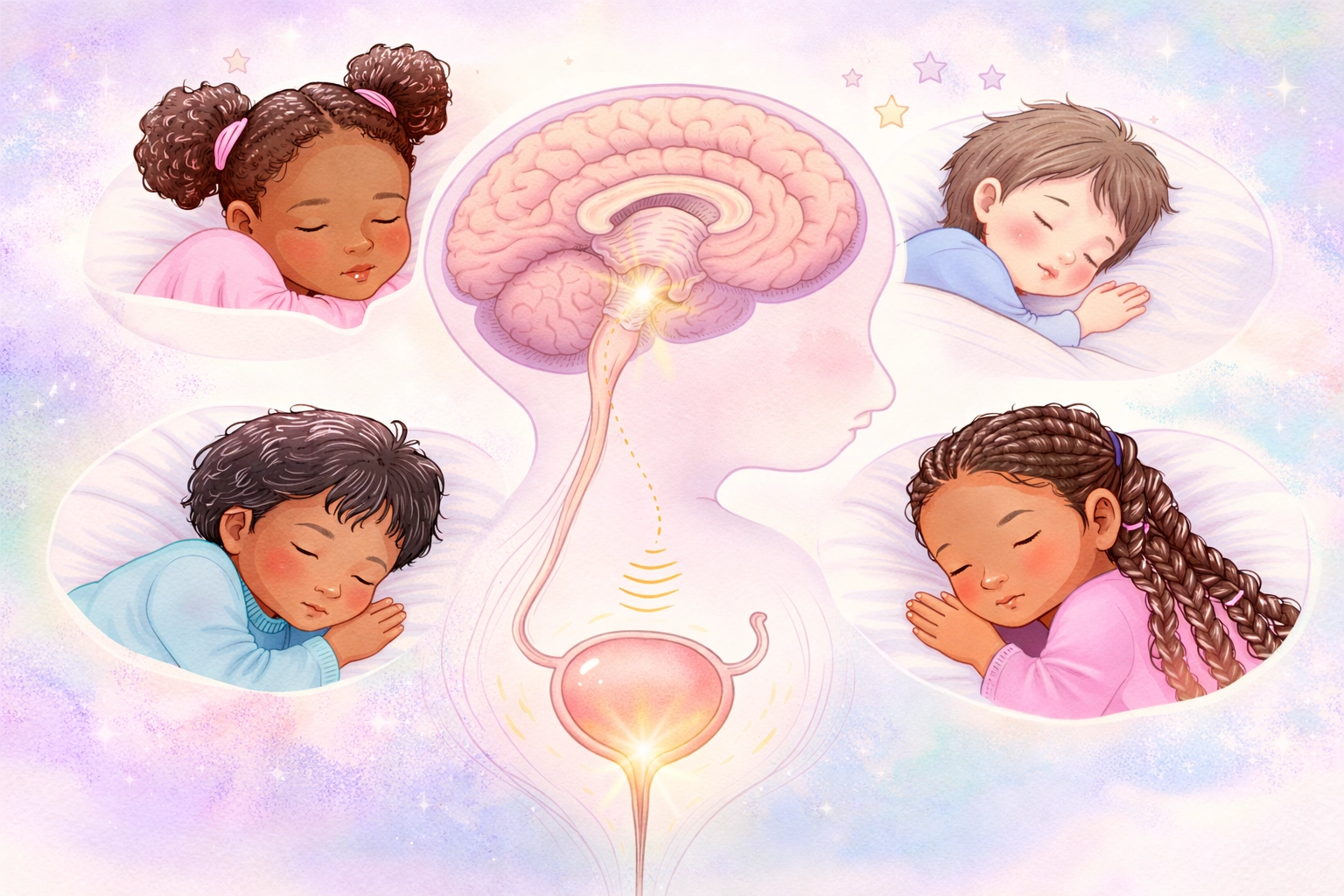
Deep inside your child’s brainstem lives a whole network dedicated to one job: deciding what’s important enough to wake up for. That network is often called the brain’s arousal system—and when it’s still maturing, bedwetting can happen even in a child who’s bright, motivated, and “tries really hard.”
The arousal system isn’t about attitude. It’s about wiring.
Arousal centers—aka the brain’s “attention + wake-up” crew
When we talk about “arousal centers,” we’re usually talking about several brain regions that work together to control:
- wakefulness
- sleep depth
- attention
- stress response
- how easily the brain switches from sleeping → waking
In kid-friendly terms, arousal centers help the brain answer this question:
> “Do I stay asleep…or do I wake up right now?”
At night, your child’s bladder is sending “incoming mail” to the brain: Hey, I’m filling up.
A mature arousal system sorts that mail correctly and says: This one is urgent—wake up.
A still-developing arousal system may sort it incorrectly and say: Not urgent—stay asleep.
The locus coeruleus: tiny brain area, huge influence
One key player is the locus coeruleus (LOH-kus suh-ROO-lee-us). It’s small, but it has a big reach—like a tiny control room with microphones and speakers wired to lots of parts of the brain.
The locus coeruleus is a major source of norepinephrine, a neurotransmitter that helps with:
- alertness
- “snap-to-it” responses
- shifting from deep sleep into wakefulness
In plain language: norepinephrine helps the brain notice signals and act on them.
When your child’s bladder is full at 2:00 a.m., they need that wake-up chemistry to kick in. If it doesn’t—because their sleep is deep, their arousal system is still maturing, or both—your child sleeps right through the signal.
Other arousal players that matter (yes, it’s a team sport)
Bedwetting science doesn’t hang on one brain structure. The arousal system is more like a group chat—multiple systems pinging each other to decide whether to wake.
Here are a few important “teammates”:
- Reticular activating system (RAS): a brainstem network that helps control wakefulness and transitions between sleep stages.
- Hypothalamus: helps regulate sleep-wake rhythms and autonomic functions (think: body regulation on autopilot).
- Thalamus: acts like a relay station—what sensory information gets passed through, and what gets filtered out during sleep.
- Autonomic nervous system (ANS): controls involuntary functions like bladder signaling, heart rate, digestion, and stress responses.
Why does this matter for parents?
Because when people say, “They’re just sleeping too hard,” they’re not entirely wrong—but they’re also not explaining the why. The “why” is neurobiology.
> Clinical note (but keep it real): pediatric bedwetting is commonly tied to a mismatch between bladder signals, sleep depth, and arousal response—plus factors like nighttime urine production and constipation. It’s rarely about a child being “unmotivated.”
The Brain–Bladder “Power Line” (And Why It Sometimes Drops the Signal)
Let’s talk about the “power line” idea—because parents get this immediately.
Picture a line running from the bladder to the brain like a phone charger. When it’s working perfectly, the brain receives the alert, wakes the body, and your child gets to the toilet.
But in many kids, that line is still under construction.
How the signal is supposed to travel
Here’s the simplified pathway:
- Bladder fills → stretch receptors in the bladder wall fire
- Signals travel up the spinal cord
- The brain processes: How full is it? Is this urgent?
- Arousal system decides: wake or sleep
- If awake, the child can inhibit bladder contraction long enough to get to the bathroom
How the signal gets “lost” at night
In deep sleep, the brain naturally turns down responsiveness. That’s normal. That’s healthy.
But if your child:
- sleeps very deeply,
- has a slower-maturing arousal network,
- has a bladder that reaches “urgent” volume faster,
- or makes more urine overnight…
…the signal may not flip the wake-up switch.
And then, yes—wet sheets.
Not because your child didn’t care.
Not because they “chose not to get up.”
Not because they were “being lazy.”
Because the signal didn’t land.
Why Deep Sleep Makes It Harder
Here’s where it gets even more interesting.
The brain’s arousal system doesn’t work like a simple on-off switch. It’s what researchers describe as a coordinated set of neuromodulatory circuits—meaning multiple chemical messengers and brain pathways working together to regulate alertness.
During deep sleep, the brain filters incoming signals aggressively. It’s protecting restoration time—growth hormone release, memory consolidation, nervous system reset. This is why kids can sleep through thunderstorms, barking dogs, and you tip-toeing into their room like a ninja.
But for a child whose arousal system is still maturing? The bladder’s message can get filtered out too.
Their brain isn’t ignoring the signal on purpose. It literally can’t “hear” it yet.

Think about it this way: if your toddler ran into the street, your brain would instantly shift into high alert. That’s your arousal system reacting to perceived danger.
But a full bladder during deep sleep? To an immature arousal system, it doesn’t register as an emergency. So the brain stays asleep—and the accident happens.
Biology Is Not a Behavior Problem (Read This Twice)
Let’s say that again for the people in the back:
> Biology is not a behavior problem.
This is one of the most important “power lines” I teach families—because it changes everything about how you talk to your child, how you set up routines, and how you protect their confidence.
What it looks like when people treat biology like behavior
When adults mislabel bedwetting as “laziness,” kids often get:
- scolded
- shamed
- threatened with consequences
- compared to siblings or peers
- lectured about “trying harder”
And here’s the heartbreaking part: most kids already feel bad. They don’t need motivation. They need a system.
What’s actually going on in most cases
Your child isn’t choosing to wet the bed. They’re not being lazy, careless, or defiant.
They’re working with:
- a brain that’s still building its wake-up circuitry,
- a bladder that sends signals,
- and sleep that sometimes blocks those signals.
That’s developmental neurobiology—not character.
Why this “biology ≠ behavior” line matters for potty training too
Sometimes parents tell me:
- “He waits until the last second.”
- “She refuses to stop playing.”
- “They act like they don’t care.”
And yes—sometimes there is a behavior layer (kids are kids). But if you see repeated patterns like urgency, frequent accidents, or constipation, don’t assume it’s purely stubbornness.
A child can be:
- distracted and genuinely not feeling signals clearly,
- anxious and holding urine too long,
- avoidant and constipated (which can compress the bladder and change urgency).
The win is this: when you address the biology, behavior often improves automatically.
A quick “myth vs. truth” reset
- Myth: “If they wanted to stay dry, they would.”
- Truth: Wanting doesn’t override sleep physiology.
- Myth: “They’re doing it for attention.”
- Truth: Most kids are mortified and would do almost anything to avoid it.
- Myth: “Punishment will fix it.”
- Truth: Shame increases stress—stress can worsen sleep and bladder patterns.
> Dr. T reminder: You can coach habits without blaming the body. That’s the sweet spot—firm and kind.
The hopeful part (because you need this)
And here’s the hopeful part: it will.
For most children, the arousal system catches up with time. The brain learns to recognize and respond to the bladder’s signals. Accidents become less frequent, then stop.
But in the meantime? Your child needs your patience, your understanding, and—most importantly—your belief that this is not their fault.
Your Questions, Answered:
Is my child lazy for wetting the bed?
Absolutely not. Bedwetting (nocturnal enuresis) is most often linked to sleep/arousal development, bladder signaling, nighttime urine production, and sometimes constipation—not laziness. Your child’s brain may not be registering the bladder’s “wake up” message during deep sleep. That’s developmental physiology, not attitude.
Why doesn't my child wake up when they need to pee?
Because the arousal system—including brainstem networks like the locus coeruleus—has to decide that a bladder signal is urgent enough to interrupt sleep. In deep sleep, the brain turns down sensitivity to signals. In kids with bedwetting, that “volume knob” is often turned down extra, or the wake-up response is slower to mature.
Can you train a child to wake up for the bathroom?
Yes—with the right tools and the right expectation. You can’t “discipline” brain development into happening faster, but you can support learning and wiring. Bedwetting alarms are one of the most evidence-supported approaches because they build an association between wetness and waking. Consistent routines, daytime hydration (earlier in the day), regular toilet sits, and constipation support also matter. If you want a structured, kid-friendly plan, explore our comprehensive, gamified approach.
At what age should I be concerned about bedwetting?
Occasional bedwetting can be developmentally normal in early childhood, but if accidents are frequent and your child is 7+, it’s reasonable to get more strategic. This still usually isn’t a sign of misbehavior—it’s a sign your child needs support, not blame.
Bonus Q&A: Potty Training, Motivation, and Behavior Concerns
Is my child being lazy about potty training?
In most cases, no—and “lazy” isn’t a helpful label here.
Potty training struggles often come down to a mix of:
- body awareness (do they reliably feel “I have to go”?)
- timing (can they stop playing and get there in time?)
- stool patterns (constipation can sabotage everything)
- sensory factors (some kids dislike the bathroom sounds, lighting, or the feeling of sitting)
- anxiety or past painful poops
If your child is having frequent accidents, urgency, or poop withholding, treat it like a skills + body signals issue first—not a character flaw.
> Power line: If the signal is fuzzy, the behavior looks messy. Fix the signal—then coach the skill.
How to motivate a child to stay dry?
Motivation works best when it’s supportive, specific, and shame-free—because dryness is a body outcome, not a moral achievement.
Try this “level-up” approach:
- Reward the routine, not the dry night.
Celebrate: trying the bathroom before bed, drinking water earlier in the day, doing the plan, using the tracker. - Use quick, visible wins.
Stickers, simple points, a small “hero mission” chart—kids do great with momentum. - Make it a team project.
Say: “We’re training your brain and bladder to work together.” Not: “You need to try harder.” - Remove fear of failure.
A child who’s scared of disappointing you often sleeps more stressed—and stress can worsen sleep depth and accidents. - Give your child a script.
“My body is still learning. I’m practicing. I’m not in trouble.” That’s confidence-building medicine.
And if you want motivation with structure, that’s exactly why we built the Bladder Breakthrough™ ecosystem—so kids can go into hero mode and parents can stop guessing. (Because you’ve been waiting for this.)
Can bedwetting be a sign of behavioral issues?
Bedwetting is usually not a behavioral problem.
However, it can be associated with (or impacted by) stress, anxiety, ADHD-related attention patterns, or big life changes—not because the child is “acting out,” but because the nervous system and sleep can be affected.
Consider extra support if you notice:
- sudden new bedwetting after a long dry stretch
- major changes at home (move, divorce, new school, grief)
- daytime urinary symptoms (frequency, urgency, pain)
- snoring, gasping, or very restless sleep (sleep-disordered breathing can affect arousal)
- significant constipation or stool accidents
- intense fear/shame around toileting
If you’re worried, loop in your pediatrician. Rule out medical contributors, then build a supportive plan. The goal is never to “blame behavior”—it’s to protect your child and get you answers.
What You Can Do Right Now

Understanding the science is powerful: but knowing how to support your child through this is even more powerful. Here are a few things you can start doing today:
- Remove shame from the conversation. Your child needs to know this isn't their fault: and they need to hear it from you.
- Celebrate effort, not just outcomes. Dry nights are great, but so is following the routine, staying positive, and trying again.
- Focus on daytime habits. Proper hydration, regular bathroom trips, and addressing constipation can all support nighttime progress.
- Consider a structured program. Tools like the Bladder Breakthrough system are designed to support the brain-bladder connection in a fun, kid-friendly way.
The Bottom Line: Your Child Is Not Broken
Bedwetting in children is one of the most common: and most misunderstood: childhood challenges. It's not about laziness. It's not about willpower. It's about a brain that's still learning how to communicate with the bladder during sleep.
And here's the best news of all: progress is absolutely possible.
With patience, the right tools, and a whole lot of compassion, your child will get there. The arousal center will mature. The brain will learn to "hear" the bladder. And those dry mornings? They're coming.
Until then, keep showing up. Keep believing in your child. And know that you're not alone in this journey.
You've got this: and so does your little one. 💪
Want more science-backed, shame-free support for your family? Explore our Nighttime Ninjas resources and discover how we're helping families turn accidents into achievements( one night at a time.)